Why is there a British town at 1,894 m?
Accounts of the “discovery” do not agree, and it is worth saying so rather than picking one. The town’s own history credits Dr John Davy with recording the plain in 1818 and puts Samuel Baker’s arrival at 1838; the standard reference work dates the founding to 1846 and to Baker. The two reconcile if Davy found it and Baker settled it. Baker left, ill, in 1866, and his name is still on Baker’s Falls in Horton Plains and on a ward at the town hospital.
The colonial furniture arrived in sequence. Governor Sir Edward Barnes (1824–31) built Barnes Hall, which is now the Grand Hotel. Sir Robert Wilmot-Horton (1831–37) wrote the plateau up. From 1872 Sir William Gregory had the Thalagala stream dammed — the work was done in 1873 — turning a bog into the 91.2-hectare Lake Gregory and freeing land for the town to grow. The railway came up from Peradeniya through Nawalapitiya to Hatton and Nanu Oya from 1877.
The economic pivot underneath all of it was a fungus. Coffee leaf rust was first reported in Ceylon’s coffee districts in 1867; planters nicknamed it “Devastating Emily”. Output fell by roughly 75%, the area under coffee collapsed by about 80% — from 68,787 to 14,170 hectares — and the industry was nearly finished by 1890. In the same year the rust appeared, the Scot James Taylor, in Ceylon since 1852, planted 19 acres of tea at Loolecondera. He built a factory there in 1872 and shipped to London in 1875. Ruined coffee land became tea.
The labour was not local. Barnes had begun recruiting Tamil workers from Tamil Nadu in 1827 at the request of the planter George Bird, under the kangany system in which a village headman signed up his own people. They landed at Mannar, were quarantined at Matale and dispersed through Kandy. By 1911 they numbered 531,000, nearly 13% of the island. The 1948 Ceylon Citizenship Act stripped them of nationality and the vote; the 1964 Sirima–Shastri Pact repatriated some 600,000 to India while granting 375,000 Sri Lankan citizenship; the remaining stateless were regularised in 1984–85 and finally in 2003. About 600,360 Malaiyaha Tamils were counted in 2024, concentrated in this district, Kandy and Matale.
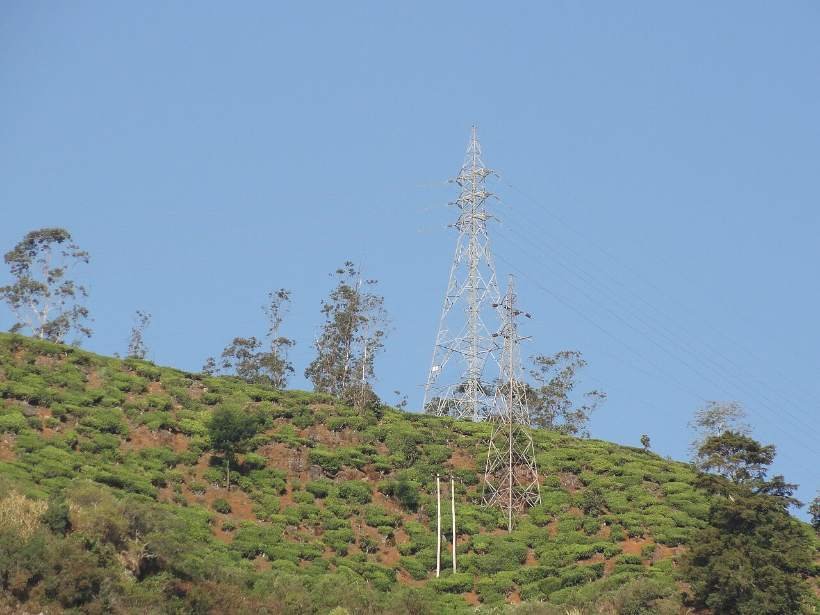 Power lines in Nuwara Eliya, Sri LankaPhoto: Rehman Abubakr (CC BY-SA 4.0)
What should you actually see in Nuwara Eliya?
- Lake GregoryA 91.2-hectare reservoir made in 1873 by damming the Thalagala, which rises on Pidurutalagala. The walking circuit and the boat jetty are on the town’s south-eastern edge, a few minutes from the centre.
- Victoria ParkEleven hectares in the town centre, formally named in 1897 for Queen Victoria’s Diamond Jubilee and begun with an oak planted by a visiting German princess. The Nanu Oya runs through it in small pools.
- Hakgala Botanical GardenTwenty-eight hectares at about 5,500 ft, 16 km out on the Badulla road. Laid out in 1861 as a cinchona nursery under G. H. K. Thwaites, switched to tea trials, and made a botanical garden in 1884. Over 10,000 plant taxa planted.
- Seetha Amman TempleEight kilometres south-east on the Badulla highway, 1.7 km short of Hakgala, identified with Ashok Vatika where Sita is said to have been held. Built by Indian Tamil estate workers, completed in the early twenty-first century, and still maintained by them.
- Pedro Tea EstateA working estate and factory about 3.5 km east of town on the Kandapola road — the closest tea factory to the town itself, and one that takes visitors.
- Damro LabookellieA working factory at around 1,500 m with a visitor tea centre and café, roughly 8 km north on the A5 Kandy road, 15–20 minutes’ drive. The easiest factory visit to fit into the drive up from Kandy.
- The Hill ClubFounded in 1876 by W. H. Walker, J. Wickwar and H. Saunders as a planters’ club with a billiard room and a bar. The present two-storey building dates from the 1930s and stands on 6.9 hectares on Grand Hotel Road, beside the Grand Hotel — originally Governor Barnes’s residence.
- Nuwara Eliya Post OfficeRed brick, Victorian, a clock tower at one end, completed in 1894 by the government Public Works Department and protected as an archaeological monument. The top floor became a holiday bungalow in 2012.
- PidurutalagalaSri Lanka’s highest mountain at 2,524 m, directly above the town. The summit is a designated ultra-high-security zone holding the central communications array and is strictly closed. Point at it; do not build a day around it.
- Hakgala, which began as a drug plantationEstablished in 1861 as an experimental cinchona plantation — the quinine crop — and only made a botanical garden in 1884, which is why the planting is what it is. 28 hectares at 5,500 feet, known for orchids and roses, and the second largest botanical garden in the country. Guides will tell you this is Sita's Ashok Vatika; that identification is tradition, not record.
What most visitors walk straight past
Everything green on these slopes is second choice. Coffee rust arrived in 1867 and drove coffee acreage down about 80%; the bushes that replaced it are the reason the district exists in its present form. The older stone terracing and drainage on some slopes was cut for coffee, not for tea, and it is still there to be pointed at.
Lake Gregory still generates electricity. In 1913 its water was routed into a tunnel feeding a hydro station at Blackpool, between the town and Nanu Oya, and it is still supplying power — an 1873 drainage scheme that became a power scheme forty years later.
Hakgala began as a malaria-drug plantation. It was laid out in 1861 to grow cinchona, the source of quinine, not ornamentals. Thwaites, who ran Ceylon’s botanic gardens, was also the man who collected the coffee-rust specimens from which the fungus was first described. The same botanist stands behind both the garden and the disease that reshaped the district.
The Hill Club’s colour bar has a date. Women and Sri Lankans were excluded from membership until 1967. It is a specific, checkable fact rather than a vague nod to colonial atmosphere.
The trout were put here deliberately. Lake Gregory was stocked in 1881, and these cold hill streams are among the few places in South Asia that hold trout at all.
The footprints at Seetha Amman are devotional tradition, not archaeology. Circular depressions in the rock across the stream are pointed out as Hanuman’s footprints, and the stream itself as where Sita bathed. Say that it is tradition and it becomes more interesting, not less.
Victoria Park is a repurposed nursery. Before 1897 it was Hakgala’s research field, so the odd mix of mature exotics is the residue of trial plantings rather than landscaping.
The line rooms are the labour history, still occupied. The terraced estate housing on the tea slopes is the physical form of the 1827-onwards recruitment; the families in them descend from workers who lost their citizenship in 1948 and did not all get it back until 2003.
First light, then again at dusk. The plateau clouds over as the day heats, so early morning is the reliable window for a clear view over the lake and the Pidurutalagala ridge. The cold that made this a British sanatorium is real — frost occurs in the wider highlands.
Where to stay in Nuwara Eliya
The centre, around Victoria Park and the racecourse, is walkable and is where the colonial hotels stand; the tea-estate hotels are 30 to 45 minutes out on single-track roads and commit you to eating in every night. Nights here are genuinely cold and almost nothing has central heating, so ask about a fireplace or extra blankets rather than assuming.
- The Grand Hotel - Heritage GrandThe 1891 governor's residence on Grand Hotel Road, five minutes' walk from the centre, with lawns, a billiard room and high tea. Average rates were roughly $160-365 in August 2026. It is the full colonial pile and worth a night for that, but the rooms are dated and some furniture is close to worn out, corridor noise carries at night, and a number of extras are charged separately. Check dates and rates →
- Heritance Tea FactoryA genuine 1930s tea factory at Kandapola converted into a hotel, reached by a single-lane road climbing through the plantations, with a restaurant in an old railway carriage. Average rates were about $140-430 in August 2026. It is properly isolated, so you eat every meal there and travellers find the food expensive for what it is; the internal walls are thin and sound travels between rooms. Check dates and rates →
- The Trevene HotelA 150-year-old colonial bungalow with ten rooms opposite Victoria Park, where staff will lay a fire in your room, at roughly $42-55 average in August 2026. It is genuinely run down and rated only 3.7 overall, with bathroom basics sometimes missing and staff not always around. Book it because you want an old house and a fire at that price, not because you want a smooth hotel. Check dates and rates →
We earn a small commission if you book through these links, at no extra cost to you. It costs you nothing and it does not change what we recommend — the notes above are what travellers actually report, not what pays best.
What do travellers actually say about Nuwara Eliya?
n = 391 traveller reports · public traveller forums · gathered August 2026
Nuwara Eliya splits the reports we gathered more sharply than any other hill stop: published itineraries give it two nights, and a good share of the most experienced advisers say cut it.
- Contradicts the guidebookNuwara Eliya is a standard two-night stop in published itineraries, and a meaningful share of experienced advisers tell people to drop it — go from Kandy or the Knuckles straight to Ella and add the night there instead, unless tea estates and cold weather are specifically what you came for.
- The counter-case comes mostly from Sri Lankans and it is strong: the weather, the food, and a recent, repeated line that you should come before it becomes a hotspot. One Sri Lankan visitor’s verdict was that two days were not enough.
- Nanu Oya is the functional station, and on the most recent reports it is now the starting point of the hill-country train rather than Kandy. Board there rather than further down the line, where it is already full.
- Concrete price dataHakgala Botanical Garden’s foreign ticket, about USD 15 and roughly twenty times the local price, is the example travellers reach for when they argue that site pricing has gone past what anyone will defend.
- The recurring stops are Gregory Lake, Victoria Park, the Pedro and Glenloch estates and Seetha Amman, with Ramboda Falls and Ambuluwawa Tower as the standard breaks on the drive up from Kandy.
- Weather is a live issue hereThis was the area guides moved people away from after the late-2025 cyclone. The hill country took the worst of it while the south coast was untouched — worth asking about rather than assuming.
Where travellers disagree. One night versus two, and whether Nuwara Eliya or Haputale is the better hill base. The one-night camp treats it as a tea-and-a-photograph stop on the way to the train; the two-night camp wants Horton Plains at dawn, which means sleeping here the night before. On the base question, Haputale wins on price, quiet and normal local pricing, and Nuwara Eliya wins on infrastructure and on being closest to the Horton Plains gate.
Questions people ask about Nuwara Eliya
Is Nuwara Eliya worth a night?
It is worth two if you want Horton Plains at dawn, because that walk starts at about 05:15 and cannot be done from anywhere else at a civilised hour except Haputale or Bandarawela. If you do not want the walk and you are not specifically interested in tea estates or cold weather, one night is enough and some experienced travellers would give you none.
Where do you catch the hill-country train?
Nanu Oya, about 8 km from town, not Nuwara Eliya. On the most recent reports the scenic service starts there rather than at Kandy, so boarding at Nanu Oya rather than further down the line is the difference between a seat and a corridor.
When was Nuwara Eliya founded?
There is no settled answer. One account has Dr John Davy recording the plain in 1818 and Samuel Baker arriving in 1838; the standard reference gives 1846 and credits Baker with the founding. Both are in print, they are reconcilable if Davy found it and Baker settled it, and a guide who gives you the range is telling you the truth.
Can you go up Pidurutalagala?
No. The summit of the island’s highest mountain, 2,524 m directly above the town, is an ultra-high-security zone holding the government and armed forces’ central communications array, and the road is closed to the public. Any itinerary offering you the summit is wrong.
How cold does it actually get?
Cold enough to matter. The town is at 1,894 m, ground frost occurs on the plateau in February, and most budget rooms have no heating and thin bedding. Bring a fleece and long trousers for the evening — people arrive from 30°C on the coast the same day and are caught out.