History of Kandy
Kandy was the seat of the last independent Sinhalese kingdom, and it held out against the Portuguese and the Dutch for three centuries before falling to the British in 1815. That is the short version of why the city feels different from the coast: it was never colonised into a port. It was a court.
It sits at about 500 metres, which is the first thing your body notices after Colombo — the air moves, the evenings are cool, and the whole place is built around a lake the last king had dug. The single most underrated thing to do here is walk. The lake circuit is roughly three and a half kilometres of flat pavement, and the loop takes in the temple, the old royal precinct, the shrines and the covered market without you ever needing a vehicle.
The Sacred Tooth Relic is what makes the city what it is. Tradition holds the Buddha’s left canine reached the island around 310 CE, carried by Princess Hemamala and Prince Dantha, and that whoever held it held the right to rule. That is not a museum fact here — it is the reason the temple, the palace and the four shrines all sit inside one walled precinct, and the reason the city empties into the streets for ten nights every year.
Give it two nights. One is enough to see the temple and leave with the impression that Kandy is a temple, which is what most people do and why most people find it underwhelming.
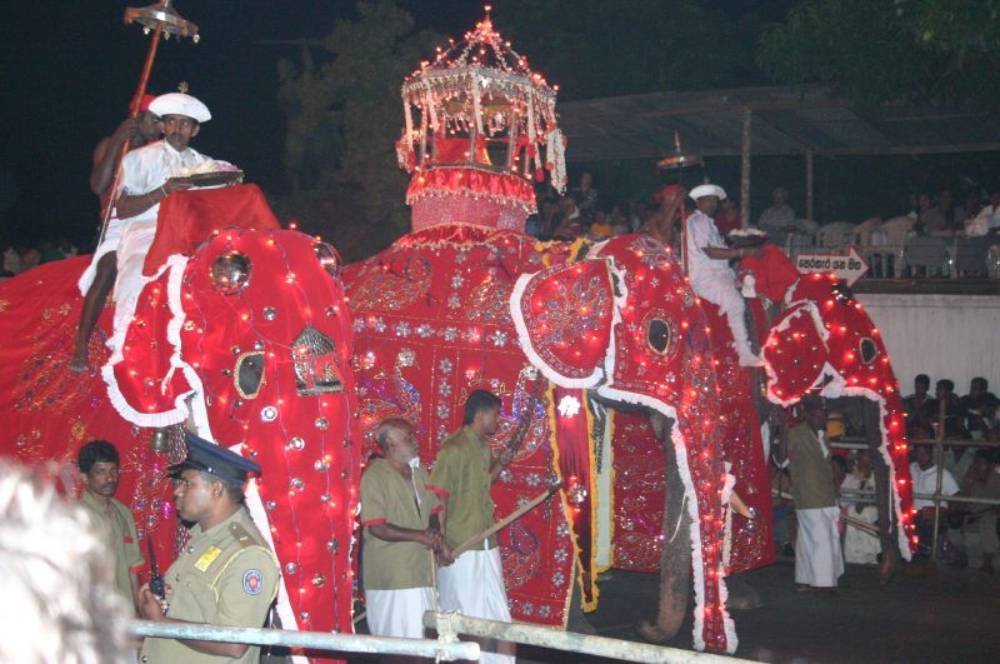 The Esala Perahera. Ten nights every July or August, and the reason to move your dates rather than your route.Photo: S B from Sydney, Australia (CC BY 2.0)
What should you see in Kandy?
- Sri Dalada MaligawaThe Temple of the Sacred Tooth Relic, and the reason for everything else in the precinct. Time your visit to one of the three daily thevava services — 05:30, 09:30 and 18:30 — rather than turning up between them, when it is a building rather than a rite.
- The four devalesNatha, Vishnu, Pattini and Kataragama, the guardian shrines. Almost every visitor walks past them to the temple and back out again, which is a mistake — they are free, quiet, and older in feel than the Maligawa itself.
- Natha DevaleThe oldest surviving structure in Kandy, 14th century, and the only one of the four dedicated to a purely Buddhist protector. Beautiful from the outside; the interior is plainer than you expect.
- Kataragama DevaleKandy’s own Kataragama, on Kotugodella Vidiya, a short walk from the others and set apart from them. Run by Hindu priests rather than Buddhist, with an ornamented vahalkada facing the street, a chamber for the Perahera palanquin and a drummers’ quarter. If you cannot get to the real Kataragama in the deep south, this is where Kandy makes its wishes.
- Vishnu (Maha) DevaleNorth of the temple, with a large dancing pavilion and a long flight of stone steps up to the shrine. Local tradition has the Buddha entrusting the island’s guardianship to Vishnu.
- Queen’s HotelOver 160 years old and one of the oldest hotels in the country. Built as the Dullawe Walauwa under King Sri Vickrama Rajasinha, taken as the Governor’s residence after 1815, then barracks, then the Stainton Hotel, and finally the Queen’s from 1869. Mountbatten drank in the bar that still carries his name. It stands at the end of the main street, directly on the Perahera route.
- Kandy Municipal Central MarketThe covered market in the middle of town. Fruit you will not recognise, spice by the sack, and the best half hour of ordinary Sri Lankan life available to a visitor anywhere in the hill country.
- Kandy Lake circuitThree and a half kilometres, flat, and best in the last hour of daylight when the whole city walks it. The lake was dug by the last king in 1807 and the parapet along the temple side is his.
- Bahirawakanda ViharaThe large white Buddha on the hill above town. Travellers who have tried both consistently rate this above the hotel viewpoints for the view over Kandy.
- Udawattakele SanctuaryThe old royal forest garden directly behind the temple precinct — genuine jungle, ten minutes from the town centre, and good for birds first thing.
- Royal Botanic Gardens, PeradeniyaSix kilometres out, and worth two unhurried hours for the orchid house and the giant bamboo. Half a day if you take it slowly.
- Embekka, Lankatilaka and GadaladeniyaThe three 14th-century temples west of the city, done as one half-day loop. Embekka’s carved wooden pillars are the finest surviving woodwork of the Gampola period.
- Embekka Devalaya, and its 514 designsA 14th-century wooden temple whose carvings run to 514 unique designs — 125 series of decorations, 256 liyawela patterns, 64 lotus designs and 30 roof patterns, counted. Look up in the Drummers' Hall for the Madol Kurupawa, the giant wooden catch-pin where 26 rafters meet, which one source says has no equal anywhere.
- Lankatilaka, and the longest Tamil inscription on the islandBuilt on bare rock in the 14th century and originally four storeys and eighty feet high; three survive. Its inscriptions are in both Sinhala and Tamil, and the historian K. Indrapala calls the Tamil one the longest found in Sri Lanka. The architect was a South Indian, Sathapati Rayar, working with Pandya sculptors.
- Gadaladeniya, cut from granite1344, and built almost entirely of sculptured granite rather than the usual brick and plaster — described as one of the largest rock temples in the country. Designed by a South Indian architect, Ganesvarachari, in a Dravidian style. Twelve and a half kilometres west of Kandy, three from Lankatilaka: all three of these are one short loop.
- Udawattakele, the forbidden forest104 hectares of forest directly above the Temple of the Tooth, and a fifteen-minute walk from it. In Kandyan times it was the garden above the royal palace and the public were barred — hence its other old name, the forbidden forest. About 80 bird species, plus the ramparts of a British garrison post and a colonial cemetery in the trees.
- GalmaduwaThe odd one out on the temple loop — an unfinished 18th-century image house built in a Hindu gopuram form rather than a Kandyan one, and abandoned mid-construction. Worth twenty minutes precisely because it does not look like anything else near Kandy.
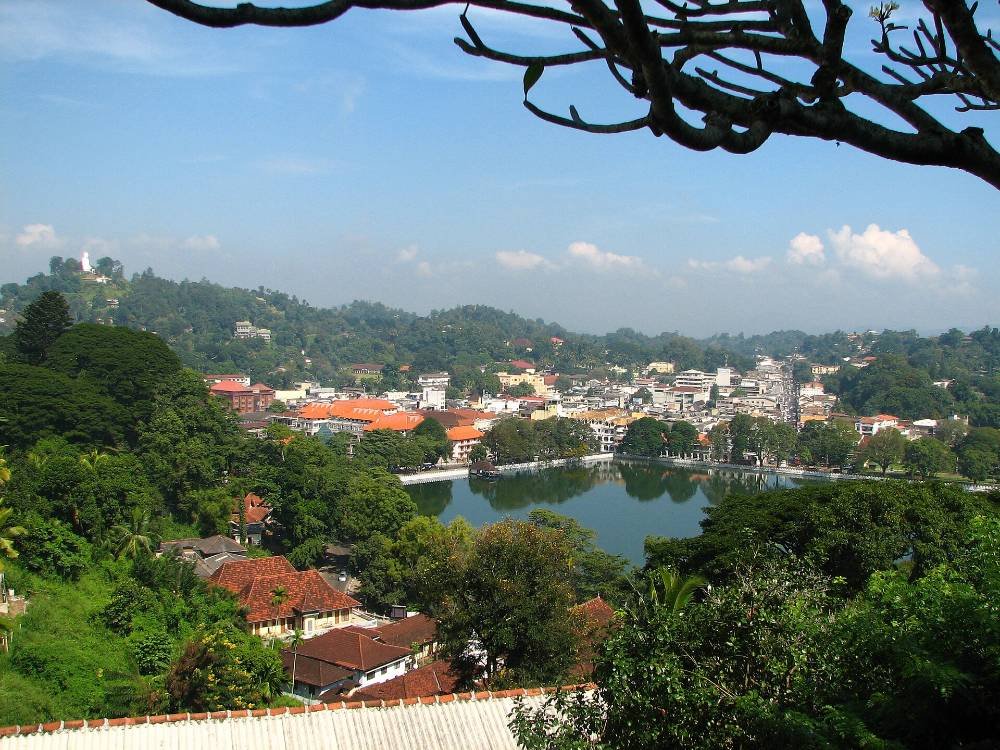 Kandy Lake and the city centre. The circuit is 3.5 km, flat, and best in the last hour of light.Photo: McKay Savage (CC BY 2.0)
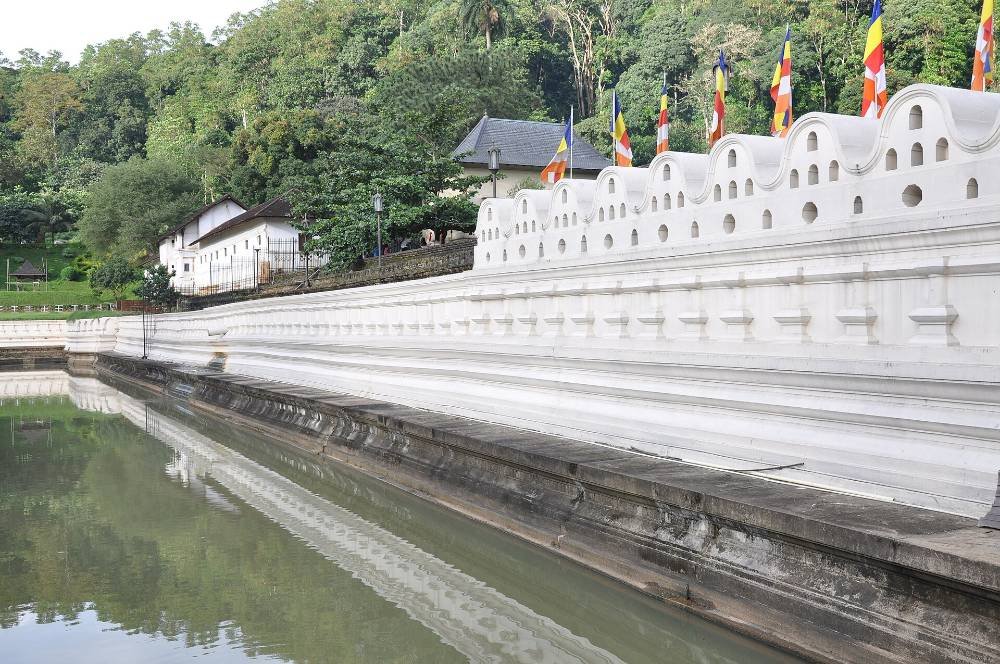 Sri Dalada Maligawa. Go to a service — 05:30, 09:30 or 18:30 — not between them.Photo: Jorge Láscar from Australia (CC BY 2.0)
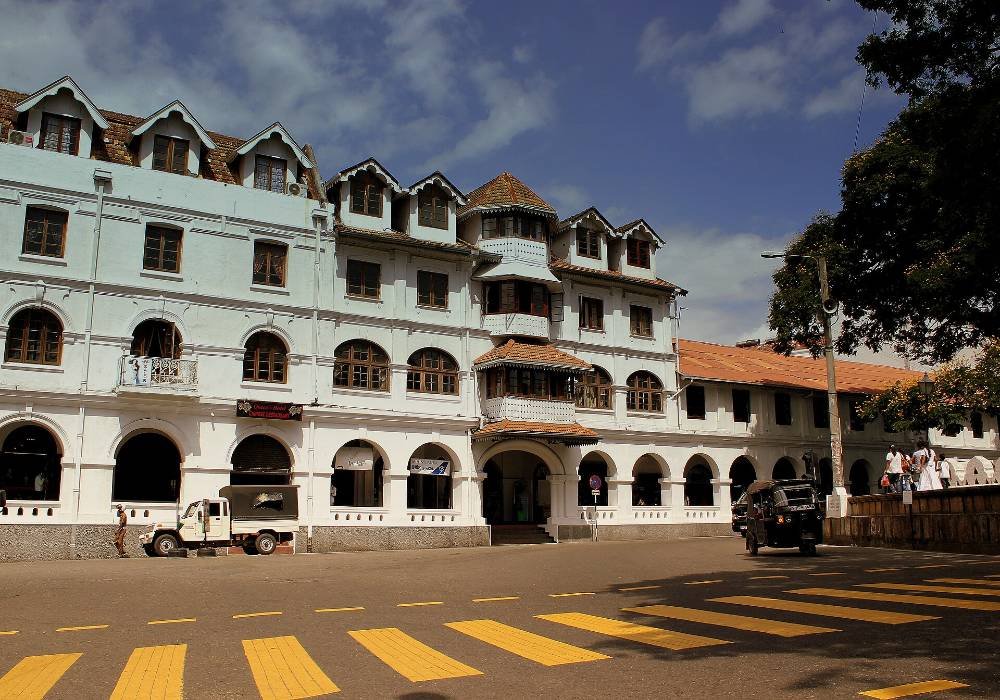 Queen’s Hotel at the end of the main street, on the Perahera route since 1869.Photo: calflier001 (CC BY-SA 2.0)
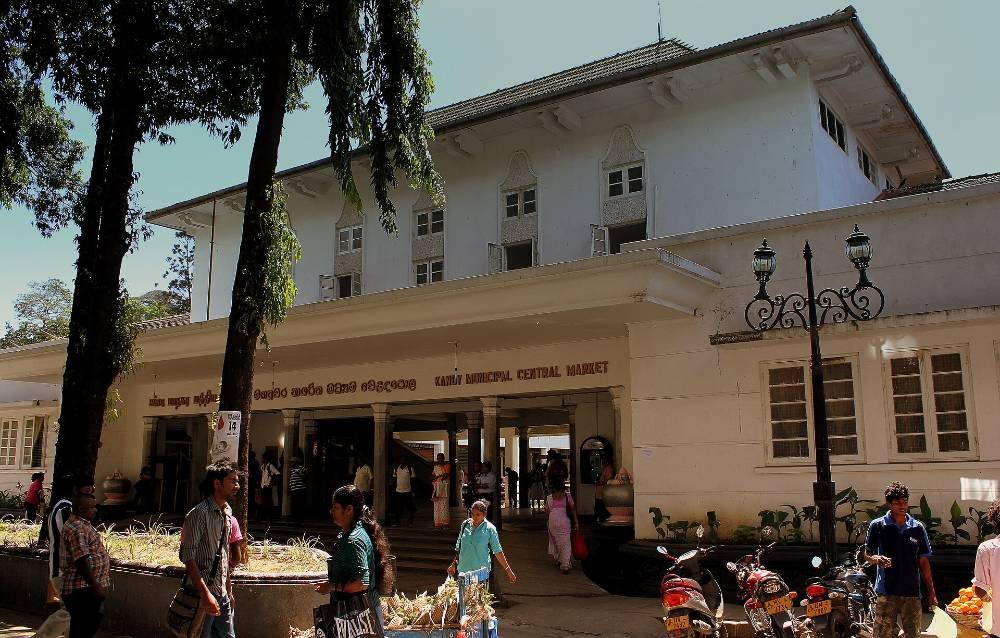 Kandy Municipal Central Market. Half an hour of ordinary Sri Lankan life, in the middle of town.Photo: calflier001 (CC BY-SA 2.0)
What is worth your time around Kandy
This is the largest Buddhist procession in South Asia and the defining event of Kandy’s year, and it is the single strongest reason to move your dates rather than your route.
The festival honours the Tooth Relic. The first procession is credited to King Kithsirimewan at Isurumuniya not long after the relic arrived, and the tradition has run through every kingdom since, continuing even under British rule with an appointed Chief Custodian. It runs for ten nights and builds. Five nights of Kumbal Perahera come first, smaller and more manageable. Then five nights of Randoli Perahera, ending with the Grand Randoli, which is the one everybody means. It closes with the Diya Kepeema, the water-cutting at the Mahaweli before dawn, and a daytime procession that afternoon.
In 2026 the Kumbal nights ran 18 to 22 August, the Randoli nights 23 to 27 August, the Grand Randoli on the 27th, and the water-cutting at 01:28 on the 28th. Dates move with the moon and are set by the temple each year, so confirm before booking anything — and if you are coming for it, book rooms months out, not weeks.
The four devales each send their own procession, which is why the shrines matter more than their quiet daytime appearance suggests. Whip-crackers, flag bearers, Kandyan dancers, drummers and caparisoned elephants come past for hours.
Be straight with yourself about the elephants. Travellers who have been are divided, and the criticism is specific: animals chained, in crowds, under lights and firecrackers, for several nights running. If that will spoil it for you, come for the Kumbal nights, which are smaller, or come another month. We will tell you the same thing on the phone.
What most visitors walk straight past
You do not see the tooth. It sits inside a series of nested gold caskets and the caskets are what is displayed. Anyone promising you a viewing is selling something.
Kandy is a walking town and almost nobody treats it as one. The temple, the shrines, the market, the lake and Queen’s Hotel are all inside twenty minutes of each other on foot. The vehicle is for Peradeniya and the western temples, not for the middle of the city.
Bahirawakanda beats the hotel bars for the view, and it costs a fraction of a rooftop drink.
The friendly stranger is a commission. There is a well-documented pattern here: someone helpful walks you to a gem or batik shop, prices run three or four times normal, and your new friend is on a cut. Our drivers sign a no-commission pledge, which is why we will never suggest a shop stop.
Street tuk-tuks and app tuk-tuks are two different prices. Travellers using the apps report fair fares; people flagging one down report multiples of it. Residents get charged too.
Embekka’s roof rests on one timber pin. The madol kurupawa, a single giant catch-pin, holds the whole structure, and there is no known parallel to it anywhere. Ask to be shown it, because you will not spot it alone.
Where to stay in Kandy
Travellers consistently report the luxury properties on the hills above the lake as expensive for what they are, and recommend a room in town near the lake instead. Kandy is walkable, so central beats elevated.
- Queen’s HotelThe 160-year-old colonial pile at the end of the main street, on the Perahera route and a two-minute walk from the temple. Three-star and dated rather than luxurious — you are paying for the address and the history, and in Perahera week for the balcony. Check dates and rates →
We earn a small commission if you book through these links, at no extra cost to you. It costs you nothing and it does not change what we recommend — the notes above are what travellers actually report, not what pays best.
What do travellers actually say about Kandy?
n = 847 traveller reports · public traveller forums · gathered August 2026
Kandy draws more discussion than any stop on the island bar Ella, and the consensus is unusually practical: the city rewards timing and walking, and punishes people who arrive for one building.
- Time the Temple of the Tooth to a prayer service rather than arriving between them. This is the most repeated practical tip for the city, by a distance.
- Contradicts the guidebookGuidebooks send people to the Esala Perahera as the highlight of the Sri Lankan calendar. It also produces the most strongly endorsed negative experience in the whole corpus, and the objection is always the same: chained elephants, in crowds, under lights and firecrackers, night after night. Both things are true and you should choose knowingly.
- Worth knowing before you goA documented shop-commission pattern: a friendly stranger walks you to “his” shop, prices run three to four times normal, and the owner is paying a middleman. The counter-move is simply never to follow anyone to a shop.
- Tuk-tuk pricing is two-tier. App-booked fares are reported as uniformly fair; street-hailed fares run to multiples, and residents report being charged too.
- Bahirawakanda, the white Buddha above town, is the local pick for the best view of Kandy, rated ahead of the hotel rooftops.
- On where to sleep, the advice runs against the hilltop photographs. The luxury properties above the lake are repeatedly called expensive for what they deliver, and the recommendation is a central room near the lake — which also makes the whole town walkable.
Where travellers disagree. Whether Kandy deserves two nights or one. The people who gave it one describe a temple and traffic. The people who gave it two describe the lake at dusk, the market, the shrines and the western temples, and rate it among their favourite towns. The difference is not the city, it is the schedule.
Questions people ask about Kandy
When should you go to the Temple of the Tooth?
To a service. There are three daily — 05:30, 09:30 and 18:30 — and the evening one is the moment, when the drums start and the chamber doors open. Between services you are looking at a beautiful building with the point removed. Shoulders and knees covered, shoes off at the door.
Do you actually see the tooth?
No, and nobody does. The relic sits inside a series of nested gold caskets and the outermost casket is what is presented. Anyone offering you a viewing is selling you something.
When is the Esala Perahera and should you plan around it?
Ten nights in July or August, dates set annually by the temple and moving with the moon — in 2026 they ran 18 to 28 August. It is the largest Buddhist procession in South Asia and rooms go months ahead. The honest caveat: the elephants are chained and worked through crowds, lights and firecrackers for several nights. Some travellers find that ruins it. The five Kumbal nights are smaller and gentler than the Randoli finale if you want the festival at lower intensity.
Where is the best place to watch the Perahera?
The route runs past Queen’s Hotel at the end of the main street, and its balcony is the traditional grandstand — reviews of the seating are mixed, so ask exactly which seats you are getting before paying. Street viewing is free but you need to be in place hours early, and hotel packages along the route sell out well in advance.
How many nights does Kandy need?
Two. One buys you the temple and an impression of traffic. Two buys you the lake at dusk, the market, the four shrines, and a morning at Peradeniya or the western temples. Three in Perahera season.