History of Aluvihare
This is where the Buddha’s teaching stopped being something people remembered and became something people could read. For roughly four hundred years after his death the whole of it — every discourse, every rule, every point of doctrine — existed only in the trained memories of monks who recited it aloud to each other in relay. Nothing was written down. Nothing needed to be, as long as the reciters kept coming.
In the 1st century BC that stopped being true. A twelve-year famine the chronicles call the Baminithiyasaya arrived alongside a South Indian invasion, and between them they were killing the men who held the canon in their heads. About sixty monks withdrew to the Mahaweli river country to survive it. When they came back it was obvious that memory alone was no longer a safe place to keep the teaching.
So five hundred scholarly monks gathered at these caves. The hard part was not the writing. It was the agreement: they recited the entire doctrine aloud, cross-checked line against line, and settled on a version all of them would accept. Only then did they take a metal stylus and score it into strips of ola — talipot and palmyra palm leaf — in Pali. It is the first time the Pali Canon was written down complete. Every printed Theravada text in the world descends from that decision, made in a cave in Matale because the alternative was losing it.
The name is about light. Aloka Vihara, the temple of light, or Aloka Lena, the cave with light — the eastern rock does not block the morning, and the caves get sun.
Then it was burned. The old library at Aluvihare was destroyed in the Matale Rebellion of 1848, along with much of the temple. Generations of monks since have been re-cutting the leaves by hand, a page at a time. The first of the three baskets of the canon was finished in 1982. The other two are still being written.
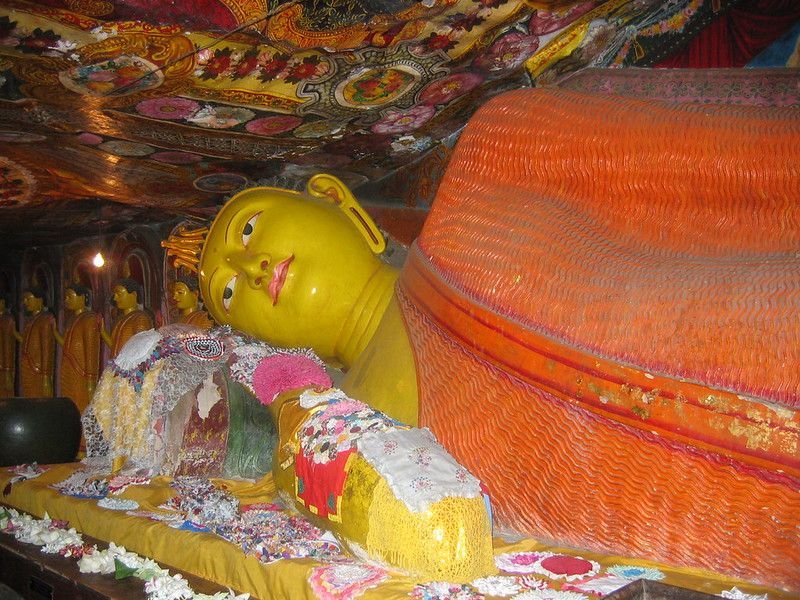 The reclining Buddha in the main cave, under painted rock. The murals are comparatively modern; the rock is not.Photo: Avi Alpert (CC BY-SA 2.0)
What should you see at Aluvihare?
- The main caveA large reclining Buddha with standing and seated figures around it, under painted rock. The murals are comparatively modern; the rock is not.
- The hell caveA second cave with another reclining Buddha, and at its entrance a wall of graphic depictions of what awaits people who do wrong — demons sawing, boiling, dismembering. Painted to be understood by people who could not read, which is the whole point of the place in reverse.
- The Buddhaghosa caveDedicated to the Indian scholar-monk who came to Sri Lanka and wrote the great commentaries on the canon these caves preserved. The cave is small and almost always empty.
- The ola-leaf writingA monk will show you how it is done: a strip of dried palm leaf, a metal stylus, and the letters scored rather than inked, then rubbed with soot to bring them up. This is the single thing to ask for here, and almost nobody does.
- The rock inscriptionsAncient inscriptions cut into the cave walls, in the caves that were monks’ quarters long before the canon arrived.
- The climb and the viewSteps and a narrow passage between boulders lead up through the complex. The top gives you Matale and the hills, and it takes minutes rather than an expedition.
- The Matale Rebellion memorialDown in Matale town, for the 1848 uprising that took the library with it. Worth two minutes if you want the other half of the story.
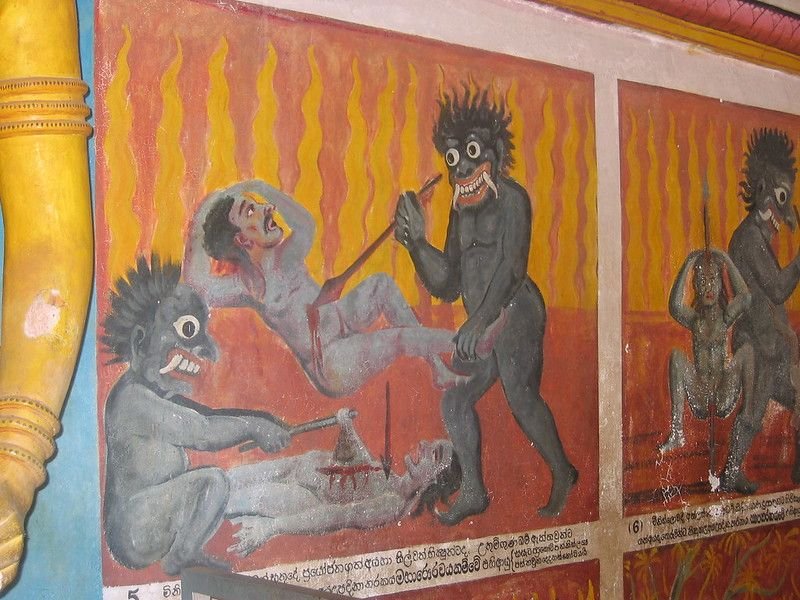 The hell cave. Demons sawing, boiling and dismembering — painted to be understood by people who could not read, which is the whole point of this place in reverse.Photo: Avi Alpert (CC BY-SA 2.0)
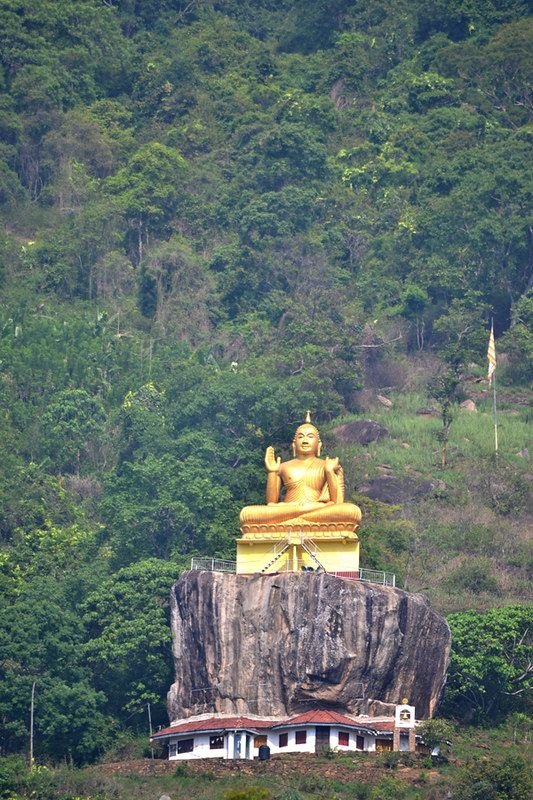 The seated Buddha above the temple, seen from the Matale road. Most people photograph this and drive on.Photo: Michael Shehan Obeysekera (CC BY 2.0)
What most visitors walk straight past
The reference books get this wrong. One widely-copied travel entry describes Aluvihare as the place where the Tripitaka was translated into Sinhala. It was not translated here. It was written down here, in Pali, for the first time — which is a different and much larger event. If a guide tells you the translation story, they are repeating a copy of a copy.
Ask to see the leaves being cut. The demonstration is the reason to come, and it is not signposted. Someone who watched a page of the canon being scored with a stylus has understood the site; someone who photographed the reclining Buddha and left has seen a cave.
It is not another Dambulla, and you should not judge it as one. Travellers who have already done Dambulla are routinely told to skip this and stop at Nalanda Gedige instead, on the grounds that the caves are similar. The caves are similar. The event is not. Dambulla is the largest painted cave complex on the island; Aluvihare is where the text those paintings illustrate was saved from being forgotten. Go for the story, not the statuary.
Nalanda Gedige is not an either-or. It sits at the geographic centre of Sri Lanka, on the same road, and takes twenty minutes. Do both. The advice to choose is advice given to people on a bus.
The rebellion that burned the library was about tax. 1848, Matale, against the British administration. The library was not the target; it was in the way. Two thousand years of preservation ended in an afternoon of somebody else’s politics.
It is thirty kilometres from Kandy and forty-eight from Dambulla, directly on the A9 between them. On the standard Cultural Triangle route you drive past the entrance. Adding it costs an hour.
Getting there, and what we do
Aluvihare is 30 km north of Kandy on the Matale–Dambulla road, which is the road nearly every itinerary already uses to get from Kandy into the Cultural Triangle. There is no detour to speak of.
The spice gardens on the same stretch are a genuine stop rather than a tourist trap if you pick a working one — pepper vines, a cocoa pod cut open, a rubber tree tapped in front of you. We take no commission from any garden, shop or showroom, and we will not deliver you to one that pays for arrivals. If you would rather skip it entirely, say so and we drive on.
What we do is get you here on the way to somewhere you were already going, wait while you go up, and ask on your behalf for the stylus demonstration if you want it.
Where to stay in Aluvihare Rock Temple
We earn a small commission if you book through these links, at no extra cost to you. It costs you nothing and it does not change what we recommend — the notes above are what travellers actually report, not what pays best.
What do travellers actually say about Aluvihare Rock Temple?
n = 3 traveller reports · public traveller forums · gathered August 2026
Three mentions in a corpus of 30,996 traveller posts, and this is the clearest case on the whole site of the data being a popularity mirror rather than a guide. Aluvihare is where a world religion’s written canon begins, and the forums treat it as an optional cave on the way to Kandy.
- Contradicts the guidebookGuidebooks pair Aluvihare with Dambulla as two cave temples. Local advisers on the forums say the opposite: if you have already done Dambulla, skip Aluvihare, because it is “almost similar experience”. Both sides are comparing caves. Neither mentions the canon.
- Where it does appear, it appears as a driving instruction — a thing you pass between Sigiriya and Kandy, listed alongside a spice garden and a Hindu temple.
- Nalanda Gedige, the geographic centre of the island, is the recommended substitute. It is a good stop and it is twenty minutes. It is not a substitute.
- Not one traveller report mentions the Pali Canon, the five hundred monks, the ola leaves or 1848.
Where travellers disagree. Whether it is worth the stop at all, if Dambulla is already on your list. The forum answer is no, on the grounds that the caves look alike. Our answer is yes, on the grounds that you are not going for the caves — and that an hour is a very small price for standing where a text was rescued from disappearing.
Questions people ask about Aluvihare Rock Temple
What actually happened at Aluvihare?
The Pali Canon — the complete Theravada Buddhist scripture — was written down for the first time here, in the 1st century BC. Until then it had been preserved entirely by memorised recitation. Five hundred monks recited it, agreed a text, and scored it into ola palm leaves with a metal stylus.
Why did they write it down when they had not before?
Because the men who carried it were dying. A twelve-year famine, the Baminithiyasaya, arrived with a South Indian invasion, and the chain of reciters that had held the teaching for four centuries was about to break. Writing was the emergency measure.
Is it true the Tripitaka was translated into Sinhala here?
No, and it is a common error repeated by several travel references. It was written down here in Pali, for the first time. Translation is a much later and much smaller matter than first committing a canon to writing.
Should I skip it if I have already been to Dambulla?
Only if you are visiting for the caves. Dambulla is the largest and best-preserved cave temple complex in Sri Lanka and Aluvihare cannot compete on painting or scale. Aluvihare is where the text was saved. It is an hour, on a road you are driving anyway, and Nalanda Gedige is twenty minutes further on — you can have all three.
What is the one thing to ask for?
The ola-leaf writing. A monk will show you a strip of dried palm leaf scored with a stylus and blacked with soot, which is exactly how the canon was preserved. It is not signposted and most visitors never see it.