History of Dambulla Cave Temple
This is the largest and best-preserved cave temple complex in Sri Lanka, and the caves were in use as a monastery in the 3rd and 2nd centuries BCE — which makes the painted ceiling above your head older than almost anything else you will stand under on this island. Tradition credits their conversion into a temple to King Valagamba in the 1st century BCE: driven out of Anuradhapura, he is said to have sheltered here for fifteen years and, on regaining his capital, built a temple in gratitude. That is tradition rather than record. UNESCO puts the monastery’s establishment in the 3rd century BCE and describes an unbroken pilgrimage tradition of twenty-two centuries.
Prehistoric occupation of the area is documented independently. The Ibbankatuwa megalithic burial ground, about 5 km south-west of Dambulla town on the Kurunegala road, has been radiocarbon-dated to 700–450 BCE and was excavated in 1983–84 and 1988–90.
By the 11th century Dambulla was a major religious centre. Nissanka Malla of Polonnaruwa gilded the caves in 1190 and added around seventy Buddha statues, recorded in stone inscriptions. His own inscriptions disagree about what it cost — one claims seven lakhs, another one lakh — which is a useful caution about medieval royal accounting.
The character visitors see today is 18th-century Kandyan. Under Kirti Sri Rajasinha (1747–1782) the caves were repainted and restatued, and roughly 80% of the surviving mural area is that campaign’s work. Cave Three, Maha Alut Vihara — the Great New Monastery — dates from it.
Later interventions are modern: arched colonnades and gabled entrances were added to the cave mouths in 1938, and nothing has been structurally altered since. UNESCO and the Cultural Triangle Project concentrated on mural conservation and visitor infrastructure between 1982 and 1996. The Golden Temple of Dambulla was inscribed in 1991 under criteria (i) and (vi). It remains a working monastery, and is described as the best-preserved ancient edifice in Sri Lanka.
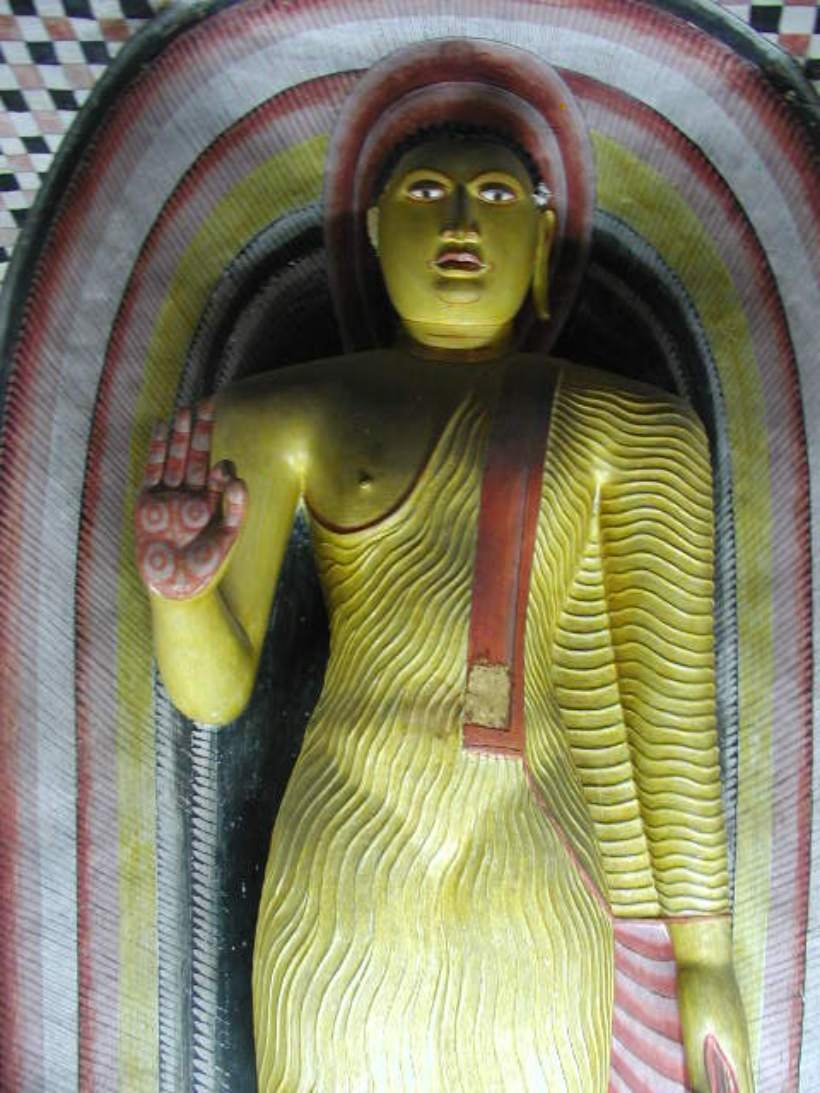 Dhambulla Cave InteriorPhoto:
What should you actually see at Dambulla?
- Cave 1, Devaraja LenaThe Cave of the Divine King, dominated by a 14 m reclining Buddha cut from the living rock, with Ananda at the feet and Vishnu at the head — and Vishnu credited in tradition with creating the caves. The image has been repainted repeatedly, most recently in the 20th century.
- Cave 2, Maharaja LenaThe largest: roughly 52 m east to west, 23 m deep and 7 m to the ceiling, with 16 standing and 40 seated Buddhas, statues of Saman and Vishnu, and portrait statues of Vattagamani Abhaya and Nissanka Malla. A rock-cut Buddha on the left is flanked by wooden bodhisattvas. This is the cave with the dagoba and the spring in the ceiling.
- Cave 3, Maha Alut ViharaThe Great New Monastery: 50 Buddha statues plus a royal statue, with ceiling and wall painting in Kandyan style from the reign of Kirti Sri Rajasinha.
- Caves 4 and 5The two smaller and later shrines at the southern end, far less visited than the first three. Their contents are not described in any source we could verify, so treat detail about them with caution.
- The drip ledgeThe channel cut along the overhang above the cave mouths to throw rainwater clear of the interiors — the reason the paintings exist at all.
- The 1938 colonnadeThe arched veranda and gabled porches added along the rock face, which is what most photographs of Dambulla actually show.
- The Golden Temple at the footThe modern Rangiri Dambulla complex and museum below the climb, with the large gilded Buddha.
- IbbankatuwaThe megalithic burial site 5 km south-west on the Kurunegala road: 42 clusters of tombs, roughly ten tombs each, spread over about 1 km², with an associated settlement of about 6 hectares. Cremated remains were found with clay pots and iron, copper and gold objects.
- Nalanda GedigeNorth on the Kandy road: an 8th–10th century shrine in South Indian Pallava style but Buddhist in use, with eroded tantric carvings compared to Khajuraho. Dismantled in the 1980s to escape the Bowatenne reservoir and rebuilt above the water on the tank bund, and considered to stand at the geographical centre of Sri Lanka.
What most visitors walk straight past
The ceiling leaks upwards. Cave 2 has a natural spring in its ceiling; the water collects, is caught in a vessel and is held to have healing properties. Someone who can show you where the water enters against gravity has the best single moment on the site.
The rock itself is the waterproofing. A drip line was cut into the overhanging rock so rainwater falls clear of the cave mouths rather than running back into the shrines. That single piece of stonework is why 18th-century tempera has survived in a monsoon climate.
Count the murals, not the caves. The painted surface runs to about 2,100 m² across the complex, roughly 80% of it 18th century. UNESCO counts 157 statues; another tally gives 153 Buddhas plus three kings and four deities. Give the range rather than one confident number.
Hindu gods stand inside a Buddhist shrine. Vishnu, Saman and Ganesha are all present. Vishnu at the head of the great reclining Buddha in Cave 1 is the one to look for, with the tradition that he made the caves.
Two kings stand among the Buddhas. Cave 2 holds portrait statues of Vattagamani Abhaya, the 1st-century BCE founder, and Nissanka Malla, the 12th-century gilder — donor portraits twelve hundred years apart, in the same room.
The paintings are a narrative, not decoration. The 18th-century tempera runs from Queen Mahamaya’s dream through the temptation by Mara to the first sermon, with historical episodes worked in alongside. Read left to right and it is a book.
The wooden bodhisattvas are the odd ones out. Maitreya and Avalokiteshvara, or Natha, in Cave 2 are carved in wood among a cave full of stone and plaster — a Mahayana presence in a Theravada shrine.
The neighbours are 2,700 years old. Skeletons from the Ibbankatuwa burials nearby are dated 700–450 BCE, and some of the gemstones in the necklaces do not occur naturally in Sri Lanka — evidence of trade centuries before Buddhism arrived. Which stones, and where they came from, is not stated in the record.
Where to stay in Dambulla Cave Temple
Dambulla town is a road junction and the country's main wholesale vegetable market, and is not a pleasant place to sleep. The better rooms are east at the Kandalama reservoir, 15 to 20 minutes out, which is quieter and no further from Sigiriya.
- Heritance KandalamaGeoffrey Bawa's best-known hotel, a long low building above the Kandalama reservoir that the jungle has been allowed to grow over, about six kilometres from Dambulla. Average rates were roughly $195-410 in August 2026. It is thirty years old and shows it in places, and lizards get into rooms at night, which is part of the design rather than a fault. You are paying for the architecture, and it is worth it. Check dates and rates →
- Amaya Lake DambullaIndividual cabanas spread across 40 acres of woodland by the lake, about seven kilometres from the cave temple. Average rates were about $90-290 in August 2026. The site is so spread out that you need a buggy to get around it, some cabanas are visibly ageing, and food and drink are priced well above the restaurants down the road. Check dates and rates →
- Gimanhala HotelA long-standing small hotel on Anuradhapura Road with a pool and a decent buffet, about ten minutes from the Golden Temple, at roughly $34-63 average in August 2026. It is on a busy road and the traffic is audible in the rooms, the building is dated, and guests have reported drain smells in bathrooms. Rated 3.7 overall, so treat it as a cheap, convenient stop rather than a destination. Check dates and rates →
We earn a small commission if you book through these links, at no extra cost to you. It costs you nothing and it does not change what we recommend — the notes above are what travellers actually report, not what pays best.
What do travellers actually say about Dambulla Cave Temple?
n = 250 traveller reports · public traveller forums · gathered August 2026
In the reports we gathered Dambulla is almost never anybody’s destination — it is a stop on the drive between Colombo or Sigiriya and Kandy. Nobody regrets treating it that way; the complaints come from people who gave it a night.
- The detail travellers repeat back is the same one the site gives: five caves, roughly 2,100 square metres of surviving murals, about 157 statues, and all of it still in active devotional use.
- Worth knowing before you goDress and footwear are the practical friction. Shoulders and knees covered, shoes off, and bring socks — the stone gets hot enough at midday to be a problem, and it is wet after rain.
- Dambulla is the road hub for the whole triangle. Air-conditioned buses from Colombo reach it in about three hours with morning departures from around 07:00, and travellers then take an app-booked tuk-tuk or a cab for the last stretch to a Sigiriya hotel.
- It is also the jumping-off point for the elephant parks. Minneriya and Hurulu Eco Park are both organised from here and from Sigiriya, and the July-to-October gathering is why August itineraries route through. One quoted private Minneriya safari ran about USD 70 plus USD 42 park entry, and going around midday beat the 14:00 crowd.
- Contradicts the guidebookGuidebooks pair Dambulla with Aluvihare at Matale as two cave-temple stops. Residents advising travellers say that if you have already done Dambulla, Aluvihare is largely the same experience, and the drive time is better spent at Nalanda Gedige — the geographic centre of the island — on the way to Kandy.
Where travellers disagree. Whether to base at Dambulla or at Sigiriya. The Dambulla camp cites hotel quality and the road position; the Sigiriya camp cites Pidurangala at dawn and the view from the room, and has more supporters. What neither camp argues is that Dambulla deserves a night on the temple’s own account — two to three hours covers it, and the caves are best treated as the reason to break a drive rather than the reason to stop.
Questions people ask about Dambulla Cave Temple
How much is the ticket?
Our sources disagree — one gives LKR 3,000, another USD 14 — so budget in the LKR 3,000–5,000 band and confirm at the gate. The ticket counter is at the main building at the base rather than at the top; a claim to the contrary circulates widely and we could not resolve it, so buy on the way in and keep the stub.
How hard is the climb?
Strenuous, and described as suitable only for the reasonably fit — the rock stands about 160 m above the plain. The exact step count is not documented in any source we could verify, so anyone who quotes you a precise number is guessing. Opening hours are given as 07:30 to 19:00 by the one source that states them at all.
What is the best time of day?
The caves face west, so the low afternoon sun reaches furthest into them and the paintings read best. Against that, the climb is far more comfortable early. Pick one and commit — trying to have both means climbing in the middle of the day, which is the worst of the options.
What should you wear?
Shoulders and knees covered, loose breathable fabric, hats off indoors, and footwear removed before you enter the temple precinct. Carry socks: the stone is hot at midday and slick after rain. Whether there is a shoe-minding fee, and what the practice around it is, we could not confirm.
Is Dambulla worth a night?
No. It is an en route stop of two to three hours and it works best that way. Sigiriya is 19 km on and is the better base, with Polonnaruwa at 67 km and Kandy at 72 km in the other direction. Keep the macaques on the stairs in mind — they are practised bag-openers.