History of Sigiriya
The rock was occupied long before the palace. The Aligala rock shelter shows Mesolithic use around 3000 BCE, and from the 3rd century BCE Buddhist monks cut and inhabited shelters on the western and northern slopes, leaving Brahmi inscriptions dated to the 1st and 2nd centuries BCE.
The dynastic story comes from the Culavamsa. Kashyapa I seized the throne in 477 CE after killing his father Dhatusena — the chronicle says by walling him up alive. His half-brother Moggallana fled to South India promising to return. Expecting invasion, Kashyapa moved the capital from Anuradhapura and built the palace and fortress complex on and around the rock during his eighteen-year reign, 477 to 495 CE.
In 495 Moggallana returned and won. The account attached to the battle — that Kashyapa’s war elephant turned aside, that his troops read the movement as retreat, and that he cut his own throat rather than be taken — is chronicle tradition, not documented fact, and should be heard as such.
Moggallana moved the capital back to Anuradhapura and handed Sigiriya to the monks. It functioned as a monastery until the 13th or 14th century, and there is no documentary record of it at all between the 14th and 16th centuries. The Kingdom of Kandy used it briefly as an outpost.
Rediscovery is dated to 1831, when Major Jonathan Forbes of the 78th Highlanders came on the brushwood-covered summit while riding back from Polonnaruwa. Small-scale archaeology began in the 1890s and H.C.P. Bell was the first to work the site extensively. The Cultural Triangle Project began systematic investigation of the whole city in 1982 — the same year UNESCO inscribed it under criteria (ii)(iii)(iv).
 Sigiriya 0161Photo: Michael Gunther (CC BY-SA 4.0)
What should you actually see at Sigiriya?
- The water gardensThree symmetrical gardens on the western precinct, with pools, causeways, underground conduits, island summer palaces and an octagonal pool with a raised podium. Among the oldest surviving landscaped gardens anywhere in the world, and the part most people walk through without looking.
- The fountainsLimestone plates fed by buried conduits from an artificial lake south of the rock, working on gravity alone. Some still play, particularly in the rainy season.
- The boulder gardensThe belt of large boulders linked by winding paths from the northern to the southern slope. Brick wall footings and cut beam sockets on the rock show that buildings once stood on top of them.
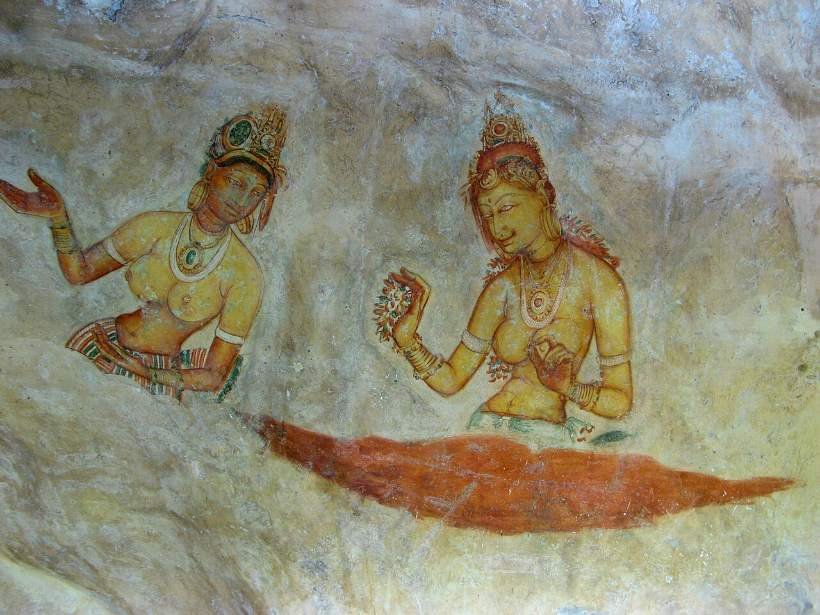
- The frescoesThe surviving painted panels on the sheltered western face. The painted zone once ran about 140 m long and 40 m high; around 22 figures are documented and 18 are cited as still visible.
- The Mirror WallThe polished plastered parapet along the fresco gallery, originally reflective, and the surface that carries the graffiti — see below, because it is the most interesting thing on the rock.
- The Lion GateThe paws and the stair between them, all that survives of a colossal brick-and-plaster lion whose head and body have collapsed. The date of that collapse is not recorded. Visitors once climbed up through the galleries and emerged from the mouth of the lion.
- The summit palaceThe flat top, with cisterns cut directly into the rock — the reason a garrison could hold it.
- Cobra Hood CaveA rock shelter named for its profile, holding frescoes painted in a noticeably different manner from those on the rock face.
- PidurangalaThe neighbouring inselberg 1 km north, the same geological origin, climbed mainly for the head-on view of Sigiriya. Separate temple-managed ticket, about LKR 1,000.
- Pidurangala, and whose monastery it wasOne kilometre north, and the rock most people now climb instead of Sigiriya for the view back at it. It was Kashyapa's own foundation — having killed his father and taken Sigiriya, he refurbished the temple here, and a brick reclining Buddha still lies in the cave below the summit. Both rocks are inselbergs: solidified magma plugs of vanished volcanoes.
What most visitors walk straight past
The Mirror Wall carries the only poetry that survives from the Anuradhapura period. Senarath Paranavitana deciphered 685 verses of the 8th, 9th and 10th centuries, and over 1,500 pieces of graffiti are recorded in total. It is described as the only surviving poetry of the Anuradhapura kingdom — and the writers include poets, provincial governors and housewives, not only the court.
Someone wrote a poem about not writing a poem. One verse, by a visitor named Budal, records that he came with hundreds of others to see Sigiriya and, since everyone else had written a poem, he did not. It is the earliest tourist joke on the island.
The graffiti mention five hundred ladies. Verses on the wall refer to five hundred women in the paintings, which means the eighteen to twenty-two surviving figures are a fragment of what those poets were standing in front of.
The brushwork is distinctive. The Sigiriya painters used sweeping strokes with more pressure on one edge, producing a deeper tone along that side. It is a technique that separates these paintings from other Anuradhapura-period work, and one reason they are compared with Ajanta.
The fountains still work after 1,500 years. They run on pressure from a lake to the south with no mechanism at all, and in the monsoon they play by themselves. This is the best engineering point on the site and it is almost always walked past.
The wasps are not wasps. They are giant honeybees, Apis dorsata. Research reported in 2022 traces attacks to visitors urinating in concealed spots: the bees congregate on the urine for its sodium and sugar, are disturbed, and swarm. The proposed fix is toilets, and a 2010 chemical burn operation failed — the bees came back the next year. Keep quiet, keep your distance, and use the facilities at the base.
The rock was already holy when Kashyapa arrived. Monks were on the western and northern slopes from the 3rd century BCE, and the site returned to monastic use for another seven or eight centuries after 495 CE. The miniature water garden, a recent discovery, was apparently built between the 10th and 13th centuries — by the monks, not by the king.
The frescoes were vandalised in living memory. Paint was thrown over them on 14 October 1967, and restoration finished on 11 April 1968.
Arthur C. Clarke wrote it into a novel. The Fountains of Paradise takes Sigiriya as its Yakkagala, and Clarke said the reality was so astonishing that he had no need to change anything. Duran Duran filmed part of “Save a Prayer” on the summit in 1982.
Where to stay in Sigiriya
Staying in Sigiriya village puts you within walking distance of the rock gate, which is what matters if you want to be climbing at opening time before the heat and the crowds. The larger resorts are strung out over several kilometres toward Kimbissa and Inamaluwa, a 10 to 20 minute drive away; Dambulla, 20 minutes south, has the restaurants.
- Jetwing Vil Uyana, A Luxury ReserveDwellings on stilts over a man-made wetland built on old farmland, with paddy, marsh and forest zones and a resident slender loris population. Average rates were roughly $290-560 in August 2026. It sits outside the village, so the rock is a short drive rather than a walk; the dining is formal in a way some guests find stiff, and it gets very hot in the middle of the day. Check dates and rates →
- Aliya Resort and Spa - Thema CollectionAbout six kilometres from the rock, with an infinity pool that lines up Sigiriya and Pidurangala in one view, which is the reason most people book it. Average rates were about $100-275 in August 2026. Food is the weak point and comes up repeatedly as mediocre, mosquitoes are a nuisance at dusk, and some rooms have poor sound insulation. Check dates and rates →
- Sigiri Lion LodgeA family-run guesthouse a few minutes' walk from the rock, off the main road, at roughly $21-32 average in August 2026 and the best value in the village. Rooms are basic and a little dated, water pressure is low and the upstairs wifi barely works. Breakfast is generous but served at a fixed time, which matters if you are leaving for a sunrise climb. Check dates and rates →
We earn a small commission if you book through these links, at no extra cost to you. It costs you nothing and it does not change what we recommend — the notes above are what travellers actually report, not what pays best.
What do travellers actually say about Sigiriya?
n = 507 traveller reports · public traveller forums · gathered August 2026
Sigiriya is the most-named single sight in the reports we gathered, and one of the very few classic stops that survives contact with reality — it appears in favourite-thing-we-did lists even from travellers who found the rest of the standard route overrated.
- Contradicts the guidebookThe sunrise most travellers rave about is climbed from Pidurangala, not from Sigiriya. Pidurangala is cheaper, opens earlier in practice, and puts the Lion Rock in the photograph instead of under your feet. The recommended pattern is Pidurangala at dawn and Sigiriya itself on another day.
- Time of day is the whole experience. The consensus is early morning or the last hour before sunset — partly the heat, partly that golden-hour light is the reason to be up there. Sri Lanka is described as an early-morning country: finish by 10:00, restart at 16:00.
- The ticket price is a live grievance. Foreign entry is repeatedly cited at roughly USD 35 a head, and this is the number people reach for when they argue that Sri Lankan site pricing has gone past what comparable countries charge.
- Worth knowing before you goTicket-desk profiling is real and worth briefing guests about. Sri Lankan and South Asian-looking visitors report being pushed towards the foreigner ticket, and in one case being refused entry until a passport was produced. SAARC passport holders should carry the passport rather than leave it at the hotel.
- Sigiriya — not Dambulla, not Habarana — is named as the best base in the Cultural Triangle. It puts Pidurangala, Minneriya about twenty minutes away, Dambulla and Polonnaruwa inside an easy radius, and the guesthouse stock is good.
- Expect persistent selling around the site: village tours, herbal and spice-garden stops, gem showrooms. Quoted prices for a village tour run to about USD 25 a person, which several travellers asked about afterwards rather than before. Residents recommend approaching from Dambulla via Kandalama Lake rather than the main road, timed for late afternoon.
Where travellers disagree. Whether to climb the rock at all once you have done Pidurangala. One camp says the frescoes, the Mirror Wall and the water gardens justify the second ticket; the other treats Pidurangala plus the view of the rock as sufficient and puts the money into a safari instead. A smaller argument runs over the herbal and spice “villages” on the approach: travellers buy king coconut oil, spice balm and sandalwood oil and then ask afterwards whether the products are genuine. No clear verdict emerges.
Questions people ask about Sigiriya
Sigiriya or Pidurangala?
Both, in that order of light. Pidurangala at dawn for about LKR 1,000 gives you the head-on view of the rock, which is the photograph you have seen. Sigiriya on a separate morning gives you the water gardens, the frescoes and the Mirror Wall, none of which exist on the other hill. If you genuinely only want one, and the view matters more to you than the archaeology, Pidurangala is the honest answer.
How hard is the climb?
The rock is about 180 m high and the ascent is on open metal staircases, exposed, in dry-zone heat. Anyone uneasy with heights or with steel stairs over a drop should be told before the ticket is bought, not at the Lion Gate. The commonly quoted step count — usually around 1,200 — is not confirmed by any source we could verify.
What time does it open?
05:00 to 18:30 daily, with tickets sold only between 05:00 and 17:00 and the fresco gallery closing at 17:45. Be at the gate for 05:00: the western face and gallery get direct sun later, the metal stairs get hot, and the bees are less of a problem before the crowds arrive.
How much is the ticket, and can you buy it in advance?
USD 35 for a non-SAARC foreign adult, USD 20 for SAARC nationals and USD 20 for a foreign child; LKR 120 for a Sri Lankan adult and LKR 60 for a child. The museum is included. Buying online through the Central Cultural Fund’s e-services site lets you skip the queue at the counter.
Are the bees actually dangerous?
They are giant honeybees rather than wasps, and attacks have been traced to disturbance where visitors urinate in concealed spots on the rock. Keep quiet, keep your distance from the nests, and use the facilities at the base. The number of active nests and any incident count are not documented in the material we have, so treat confident claims about how often it happens with caution.