History of Polonnaruwa
Polonnaruwa was a Sinhalese military post before it was a capital, recorded under the older name Pulastya nagara. The Cholas took it, renamed it Jananathamangalam and governed the island from it — Rajaraja I built a Shiva temple there for his queen, the Vanavan Mahadevisvaram, which survives as Siva Devale and gave up bronzes of Ganesha and Parvati.
Vijayabahu I ended Chola rule in 1070 after a seven-month siege with three converging armies, and founded the Kingdom of Polonnaruwa. The city’s peak belongs to his grandson Parakramabahu I (1153–1186), whose stated principle was that no drop of rain should reach the sea unused. He built the irrigation network that fed the kingdom, headed by the Parakrama Samudra — he called it a sea — along with the Alahana Pirivena monastic university, the Lankatilaka image house and Gal Vihara.
Nissanka Malla (1187–1196) added the Hatadage, Rankot Vehera, the Nissanka Latha Mandapaya and the Gal Potha, and inscribed his own achievements on everything he could reach. Scholars have noticed his numbers contradict each other: two of his own inscriptions give the Dambulla spend as seven lakhs and as one lakh.
The throne weakened after him, and in 1214 Kalinga Magha’s invasion burned both Anuradhapura and Polonnaruwa. UNESCO inscribed the Ancient City in 1982.
 Polonnaruwa galvihara1Photo: No machine-readable author provided. Jolle~commonswiki assumed (based on copyright claims). (CC BY-SA 3.0)
What should you actually see at Polonnaruwa?
- Gal ViharaFour figures cut from one granite face — seated at 4.64 m, a small seated image inside the Vijjadhara Guha cave, standing at 6.93 m and reclining at 14.12 m. The rock was cut back about 15 ft to make room. This is the reason to come.
- The VatadageA circular relic house on two platforms, 37 m across at the base, enclosing a stupa with four seated Buddhas at the cardinal entrances. Its northern moonstone and eastern guardstones are cited as the finest stonework of the period.
- The Gal PothaA granite slab 8.2 m by 1.4 m carrying 72 lines in three columns — over 4,300 characters of Nissanka Malla’s lineage, works, tax policy and advice to his successors.
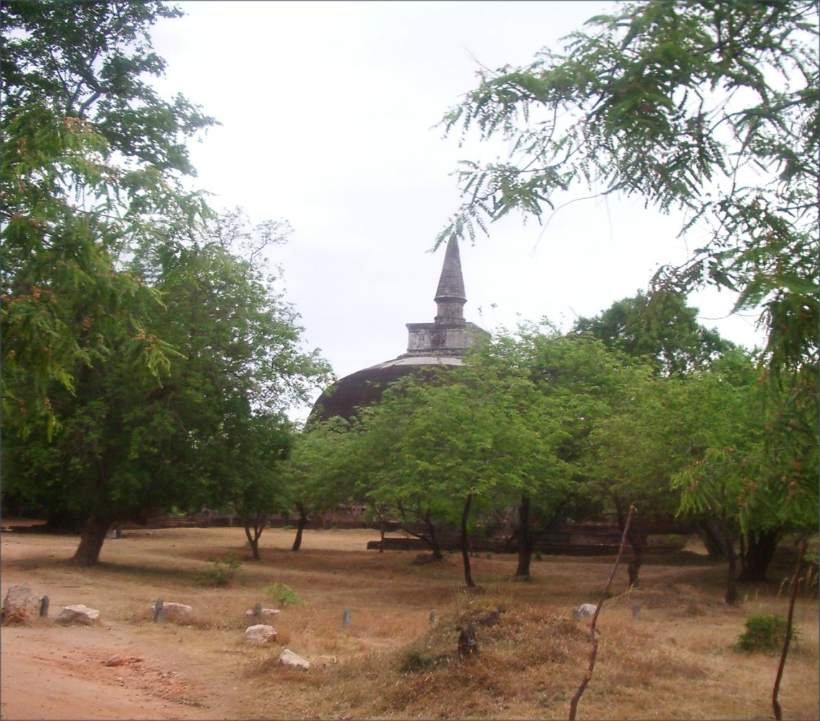
- Rankot VeheraNissanka Malla’s stupa: 550 ft around the base, 108 ft high today and possibly near 200 ft when new. The largest here and the fourth largest in the country.
- LankatilakaA brick image house said to have risen five storeys, its surviving entrance pillar about 17.7 m, holding a brick Buddha originally around 12.5 m and now headless above the shoulders.
- Kiri VeheraBuilt by Queen Subhadra, and the one stupa of the period that has kept most of its original lime plaster after eight hundred years. It shows you what all the others looked like when they were new.
- Thivanka PilimageNamed for the three-bend pose of the Buddha inside, with Jataka frescoes on the interior walls. At the far end of the site — the reason a full day beats a half.
- Parakrama SamudraFive linked tanks — Thopa, Dumbutulu, Erabadu, Bhu and Kalahagala. Topa Wewa dates from around 386 CE. The town beside it is the only inland town in Sri Lanka that reads as deliberately planned.
What most visitors walk straight past
The standing figure at Gal Vihara is an open argument. Some scholars read it as the monk Ananda grieving at the Buddha’s deathbed. Paranavitana read it as the Buddha himself, in the pose of sorrow at the sorrow of others. Look at the face before anyone tells you which.
None of it was meant to be seen in the open. Brick walls survive at the foot of each Gal Vihara statue — every figure once stood inside its own painted image house, and traces of fresco remain.
The monastic reform code is cut between the statues. Parakramabahu I’s katikavata, his rules for monastic conduct, is inscribed on the polished rock between the cave and the standing image. A legal document placed where monks could not avoid reading it.
The Gal Potha was dragged here. Its own text says the slab came from “Segiri”. Scholars split on whether that means Mihintale, about 70 km away, or Sigiriya, about 27 km. There is also evidence molten metal was poured into the cut letters to make them read.
Sixty hours, or sixty relics. The Hatadage’s name is explained either way, and the Gal Potha repeats the sixty-hours claim — which is exactly the kind of number Nissanka Malla’s inscriptions inflate.
The Lankatilaka stairs are almost unusable at roughly 10 cm wide by 30.5 cm high, which tells you the upper storeys were meant for very few people.
The macaques are a dataset. The toque macaque is endemic and Endangered; three subspecies are separated by head-colour pattern, and the troop in the ruins is the dry-zone form.
Where to stay in Polonnaruwa
We earn a small commission if you book through these links, at no extra cost to you. It costs you nothing and it does not change what we recommend — the notes above are what travellers actually report, not what pays best.
What do travellers actually say about Polonnaruwa?
n = 62 traveller reports · public traveller forums · gathered August 2026
Polonnaruwa produces the single strongest positive consensus of any site in the forum reports we gathered — and it is a complaint that not enough people go.
- Contradicts the guidebookThe recurring argument is that Polonnaruwa is under-visited relative to its quality. It holds far more standing fabric than the older capitals, it is compact enough to see properly in a morning, and the comparison people reach for is Angkor — contemporary with it, and built by another hydraulic civilisation.
- The standing Buddha at Gal Vihara is the single most-named favourite object at the site.
- It is a summer stop, not only a dry-season one. Travellers place it on the drive east between June and September, when the south-west is wet and the east coast is in season.
- Bicycle in the morning, Minneriya safari in the afternoon, is the standard local day plan — written by operators and by travellers alike.
- Expect the same persistent souvenir and tour selling as Anuradhapura and Sigiriya. “No” is not accepted first time.
- Worth knowing before you driveResidents name the Habarana–Polonnaruwa road as a stretch where police stop vehicles repeatedly for white-line violations — several times inside twenty minutes, in one account.
Where travellers disagree. Whether Polonnaruwa deserves its own night or works as a half-day from a Dambulla base. Most itineraries treat it as a day trip. The people who rate it highest argue that exactly that pace is why it stays under-visited.
Questions people ask about Polonnaruwa
Is Polonnaruwa worth it if you have already seen Anuradhapura?
They are not substitutes. Anuradhapura is older, holier and more spread out — a living pilgrimage city. Polonnaruwa is medieval, compact and far better preserved, and its sculpture is the finest on the island. If you only have time for one and you want to see rather than to feel, take Polonnaruwa.
How long does Polonnaruwa take?
Half a day covers the Quadrangle, Gal Vihara and Rankot Vehera at a decent pace. A full day lets you add Thivanka and Pothgul Vehera at the far ends of the site without rushing.
Can you cycle around the ruins?
Yes, and you should. Bicycles hire at the gate for about Rs 500 a day. The site is flat, partly shaded, and far more pleasant on two wheels than in a vehicle.
What is the best time of day?
Be there when it opens and go straight to Gal Vihara, before the sun is on the rock face and before the coaches. The Quadrangle group takes late-afternoon light better.
What should you wear?
Shoes come off on the Dalada Maluwa terrace and at Gal Vihara, and the stone is punishing by midday — carry socks. Shoulders and knees covered.