History of Horton Plains
The plateau’s Sinhala name is Maha Eliya Thenna, the great open plain, and it predates any European visit. It was renamed for Sir Robert Wilmot-Horton, British governor of Ceylon from 1831 to 1837, who came up in 1836. Baker’s Falls on the loop carries the name of Samuel Baker, the same man associated with the founding of Nuwara Eliya, who was in the highlands from the late 1830s and left for England, ill, in 1866.
Protection came late and in two steps: a nature reserve on 5 December 1969, a national park on 18 March 1988. In July 2010 it was inscribed on the UNESCO World Heritage list as part of the Central Highlands of Sri Lanka serial property, alongside the Peak Wilderness Sanctuary and the Knuckles.
The park’s recent history is ecological rather than political. Forest dieback was first reported in 1978 and has affected 22 plant species, hitting Calophyllum walkeri hardest; the causes identified are water deficiency and increasingly severe frost. Invasive gorse, Crofton weed, mist flower and bracken have spread through the grassland. The endemic freshwater shrimp Caridina singhalensis, which needs water below 15°C, is down to roughly 10 km of a single stream. Against that, the park keeps producing discoveries: the Horton Plains slender loris, one of the world’s most endangered primates, was first photographed here in July 2010, and the rusty-spotted cat was first recorded in the park in 2016 at 2,084–2,162 m.
The rock underneath is Archaean and Precambrian — khondalites, charnockites and granitic gneisses — weathered to red-yellow podsolic soils. That is why the grassland is thin, the drainage is fast and the streams run clear and cold.
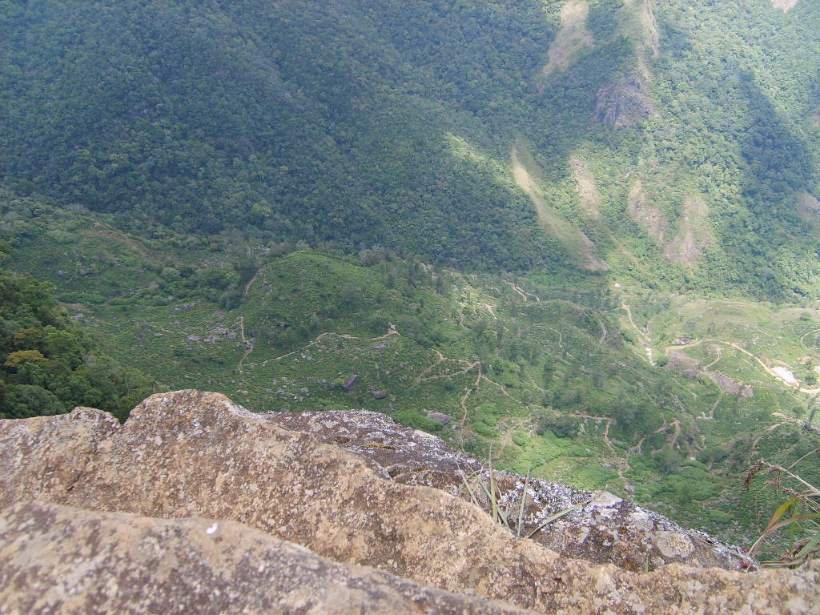 World's End in Horton PlainsPhoto: Chamal N (CC BY-SA 3.0)
What is worth your time around Horton Plains
- World’s EndThe escarpment where the plateau stops. The drop is given as 870 m by one source and 880 m by another; take the range. About 4 km from the trailhead, and the edge is unfenced.
- Mini World’s EndThe smaller precipice, a drop of about 270 m, reached first if you walk the loop clockwise. A useful rehearsal, and the fallback when the main viewpoint has already clouded in.
- Baker’s FallsA 20 m waterfall on the Belihul Oya in cloud forest, about 3.3 km from the trailhead and normally the third stop on the circuit. The rock scrambles nearby are where guides look for endemic lizards.
- The main loop trailA circuit of about 9.3–9.4 km back to the car park, walkable in either direction, 3–4 hours with stops. It is foot-only: there is no vehicle option inside the park.
- KirigalpottaAt 2,388 m, Sri Lanka’s second-highest mountain and the highest summit in the country actually open to the public — Pidurutalagala’s is not. A single seven-kilometre trail leads up from inside the park, and it sees very few walkers.
- Thotupola KandaThe third-highest peak at 2,357 m, on a trail of roughly two kilometres near the Pattipola entrance. The summit shrubbery is Strobilanthes, Osbeckia and Rhodomyrtus.
- The patana grasslandAround 2,000 hectares of wet montane grassland, the largest such habitat in Sri Lanka, and the reason the sambar are visible at all rather than hidden in forest.
- The cloud forestAbout 1,160 hectares of subtropical montane evergreen forest with a canopy of roughly 20 m. Twenty-seven of its 54 woody species — half of them — grow nowhere but Sri Lanka.
- Pattipola and Ohiya gatesPattipola in the north is about 45 minutes from Nuwara Eliya and is also the highest railway station on the island’s main line. Ohiya in the south is about 45 minutes from Bandarawela and is the natural approach from Haputale or Ella.
What most visitors walk straight past
Why 06:00 and not 09:00. As the lowlands heat, warm air rises against the escarpment and a thermal inversion forms; World’s End is fog-locked from around 09:30 on most days of the year. The whole logic of the pre-dawn start is that one meteorological fact, and it is worth explaining rather than simply enforcing.
Sambar deer, and how many. The park holds an estimated 1,500–2,000 — the densest concentration in Sri Lanka. They graze the open patana at the edges of the day and are the near-guaranteed mammal sighting.
Three endemic birds this is the place for. Of 87 recorded species, 21 endemics are shared with the Peak Wilderness, but the dull-blue flycatcher, Sri Lanka white-eye and Sri Lanka wood pigeon are the ones you come here for. Sri Lanka bush warbler and Sri Lanka whistling-thrush are also present.
The grey trees are a datable climate story. The standing skeletons among the living canopy are the dieback first reported in 1978, driven by water stress and hardening frost, with Calophyllum walkeri worst hit. You can walk a client through it in ten minutes.
A shrimp in ten kilometres of stream. Caridina singhalensis survives only where the water stays under 15°C and is now confined to roughly 10 km of one watercourse. It is the sharpest single indicator of what warming does to this plateau.
February frost on a tropical island. Ground frost is common in February, and the daily range runs from about 5°C at night to 27°C in the sun. Six degrees north of the equator.
A primate hid here until 2010. The Horton Plains slender loris is nocturnal and so rarely seen it was not photographed until July 2010. It is not a realistic sighting on a day walk — but the fact that a primate could stay hidden in a 31.6 km² park for that long tells you what the cloud forest is like.
The plastic ban is enforced at the gate, not on the honour system. Bags are searched on arrival and single-use plastics — carrier bags, food wrappers, disposable water bottles — are confiscated before you go in. Decant water into a reusable bottle at the hotel and unwrap snacks in advance, or you will lose them.
Thotupola means “landing place” (legend). The name is glossed as the spot where Ravana’s flying machine first touched down with the abducted Sita — the same Ramayana thread that runs through Seetha Amman and the Ella caves. Told as legend, it is a good story; told as fact, it is not.
Where to stay in Horton Plains & World’s End
We earn a small commission if you book through these links, at no extra cost to you. It costs you nothing and it does not change what we recommend — the notes above are what travellers actually report, not what pays best.
What do travellers actually say about Horton Plains & World’s End?
n = 36 traveller reports · public traveller forums · gathered August 2026
Thirty-six reports, which is a modest number — and the first thing almost all of them raise is the price.
- Concrete price dataForeign entry is repeatedly cited at over USD 80 for two people, and Horton Plains is the specific example used in the most widely-endorsed complaint about Sri Lankan attraction pricing going beyond what comparable countries charge.
- It is foot-only, and that single fact drives several itinerary decisions. The named alternative for anyone who will not walk a 9 km loop is the Devil’s Staircase jeep track between Ohiya and Kalupahana, done by 4x4.
- Dawn or do not bother. Travellers who arrive at 09:00 are told plainly that they have left it too late, and they are the ones who come back saying the view was not worth the money.
- Contradicts the guidebookThe World’s End viewpoint photograph is now treated as a documented safety problem rather than a highlight. A student went over the edge posing for one and was pulled back by a safari driver who climbed down after her; the same warning lists comparable incidents at Ella Rock, Little Adam’s Peak and on the train.
- Residents recommend it to people who want cool air and a walk, not to people who want wildlife. It is grouped with the Pekoe Trail and the Knuckles rather than with the national parks — which is a useful correction if a guest is expecting a safari.
- Litter and wildlife-feeding inside the park are raised by Sri Lankans as an ongoing conservation failure. January and February are the months named as reliably dry for the highlands, and they are when the view actually pays off.
Where travellers disagree. What it costs, and whether it repays it. Three sources give three gate prices — USD 25 plus a USD 8 service charge, USD 25 plus 18% tax, and an all-in figure of about USD 42 — and last entry is published as both 15:00 and 16:00. Budget USD 35–45 a head and confirm at the gate. The value argument tracks the weather almost exactly: the people who walked in before eight rate it highly, and the people who arrived at nine do not.
Questions people ask about Horton Plains & World’s End
How much does Horton Plains cost?
Budget USD 35–45 per foreign adult all-in and confirm at the gate. The published figures do not agree: a USD 25 park fee plus a USD 8 service charge in one place, USD 25 plus 18% tax in another, and an all-in quote of about USD 42 from an aggregator. There are also local, child and per-vehicle rates.
What time do you have to leave Nuwara Eliya?
About 05:15. The Pattipola gate is roughly 45 minutes away, gates open at 06:00, and the loop takes 3–4 hours with stops. Coming from the Ohiya side, Bandarawela is about the same drive. Anything later and you are walking to World’s End in cloud.
Can you drive round it instead of walking?
No. The loop is foot-only, and there is no vehicle route to the viewpoints. If a guest will not walk 9.3 km, the alternative travellers name is the Devil’s Staircase jeep track between Ohiya and Kalupahana by 4x4 — a different day out, not a substitute view.
What do you need to wear?
Expect 8–15°C at 06:00 at around 2,100 m, with wind and horizontal drizzle. Visitors routinely arrive in shorts and a t-shirt having been at 30°C on the coast a few hours earlier, and get genuinely cold. Layers, a rain shell and a hat, and shoes you can walk 9 km in.
Why do they search your bag at the gate?
Single-use plastics are banned and the ban is enforced on arrival — carrier bags, food wrappers and disposable water bottles are confiscated. Decant water into a reusable bottle before you leave the hotel and take snacks out of their wrappers, or you will lose both. Staying on the marked path is also enforced throughout.