History of Trincomalee
Trincomalee’s history is the history of one rock and one harbour. The Shiva shrine on Swami Rock — Koneswaram — is one of only two places in Sri Lanka sung in the Tevaram, the Tamil Shaiva canon: Sambandar hymned it as Thirukkonamalai in the 7th century. It is named in stone by the early 11th century, in the Nilaveli inscription, as Maccakesvaram at Tirukonamalai. You will read almost everywhere that it appears in the Vayu Purana around 300 CE. We checked, and that does not hold up — the Vayu names Lanka but not this shrine, and the hymn and the inscription are the older solid ground anyway. A figure remembered as Kulakottan of the Chola line rebuilt and expanded it, though his dating is genuinely contested and estimates run from the 1st century BCE to the 5th century CE. Pallava craftsmen are credited with the thousand-pillared hall between 537 and 668 CE, Pandyan patronage strengthened after 815, an inscription of 1223 records donations at the Tamil New Year, and in 1262 Jatavarman Veera Pandyan I planted the Pandyan bull standard on the promontory.
On 14 April 1622 — Tamil New Year — the Portuguese general Constantino de Sá de Noronha attacked. Priests were killed and the main structure was levered off the cliff into the sea; demolition was finished by 1624, and the stones went straight into the fort the Portuguese completed that same year. Fleeing priests buried some of the bronzes, and the temple at Thampalakamam was built between 1639 and 1689 to shelter the processional idols that survived.
The Dutch took the fort in 1639 under Antonie Caan and rebuilt it. The French won the naval Battle of Trincomalee in 1782; Britain took the town in 1795, renamed the fort Fredrick and held it until 1948; the Imperial Japanese Navy struck the harbour and airfield in April 1942 during the Indian Ocean Raid.
The temple came back in stages. In 1950 workers digging a water well about 500 yards from the site uncovered tenth-century bronzes — Somaskanda Shiva, Chandrasekhar, Parvati, Mathumai Ambal and Ganesha. In 1956 Mike Wilson and Arthur C. Clarke, diving off the rock, found masonry, carved columns and idols on the seabed and recovered a lingam. The old images were reinstalled in a rebuilt shrine on 3 March 1963, roughly 340 years after the demolition, and the chariot festival resumed in April 2003 — 379 years after it stopped.
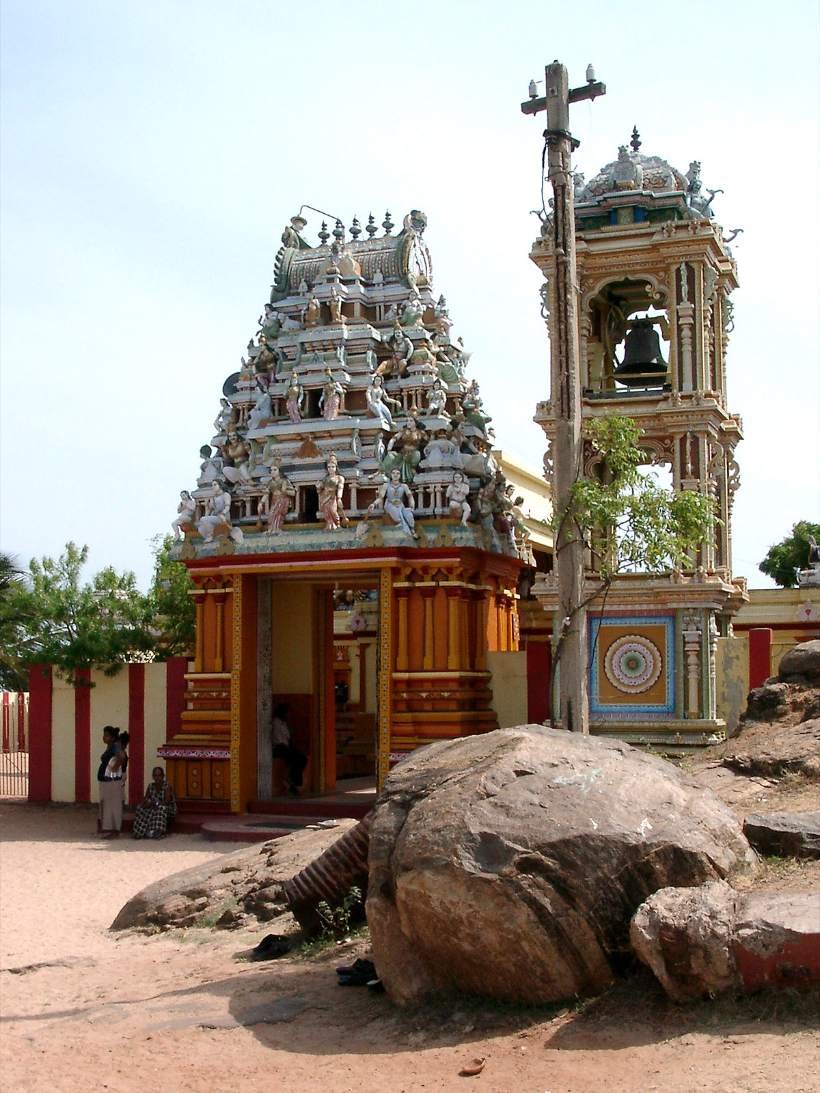 Sri Lanka Trincomalee TempelPhoto: Dschen Reinecke (CC BY-SA 3.0)
What should you actually see around Trincomalee?
- Koneswaram Temple, Swami RockThe rebuilt Shiva shrine on a cliff that drops about 120 m straight into the sea, roughly 3 km from the town centre and reached through Fort Fredrick’s gate. This is the reason to come.
- Fort FredrickCompleted by the Portuguese in 1624 out of Koneswaram’s own stone and carved pillars, still garrisoned by the Gajaba Regiment but open to visitors — the road to the temple runs straight through it.
- Pigeon Island National ParkTwo islands about 1 km off Nilaveli, 10 to 15 minutes by boat, holding roughly 100 coral species and 300 reef fish species. Open 06:00–18:00, ticket counter closing at 16:00; allow two to three hours.
- Nilaveli beachThe long open beach 16 km northwest of town, 25 to 30 minutes by road, with the resorts sitting behind it.
- Uppuveli beachAbout 6 km north of town — closer, busier, and the departure point for the whale boats.
- Kanniya hot wellsSeven square-built wells, each only 3 to 4 ft deep, about 8 km northwest on the Anuradhapura road. A protected monument since 9 September 2011.
- Velgam VeheraA 2nd-century-BCE Buddhist monastery about 10 km northwest near Kinniya, renamed Rajarajaperumpalli under the Cholas and excavated from 1953.
- Marble BeachA sheltered air-force-managed cove roughly 16 km from town, calm enough for weak swimmers.
- Seruwila Mangala Raja Maha ViharaThe ninth of the sixteen Solosmasthana, holding the forehead relic, about 45 km away via Kantale through forest.
- Fort Frederick, and what it is built fromThe Portuguese completed this fort in 1624 out of the rubble of Koneswaram — the temple they had destroyed two years earlier. Wikipedia is blunt about it: the temple stones and its carved pillars were used to construct the fort. You are walking through the walls of a Hindu temple.
- What happened on 14 April 1622Koneswaram — which the Portuguese themselves called the Temple of a Thousand Pillars — was attacked and destroyed by Constantino de Sá de Noronha on Tamil New Year's Day, and levered over the cliff into the sea. The detail that makes it worse: the Portuguese had been drawing 1,280 fanams a year as a fee to protect the temple they then demolished.
- Wellesley LodgeInside the fort is the bungalow where Arthur Wellesley stayed as a colonel, long before he became the Duke of Wellington. It is now an officers' mess for the Gajaba Regiment, which still garrisons the fort — so it is a working army post you happen to be allowed to walk through.
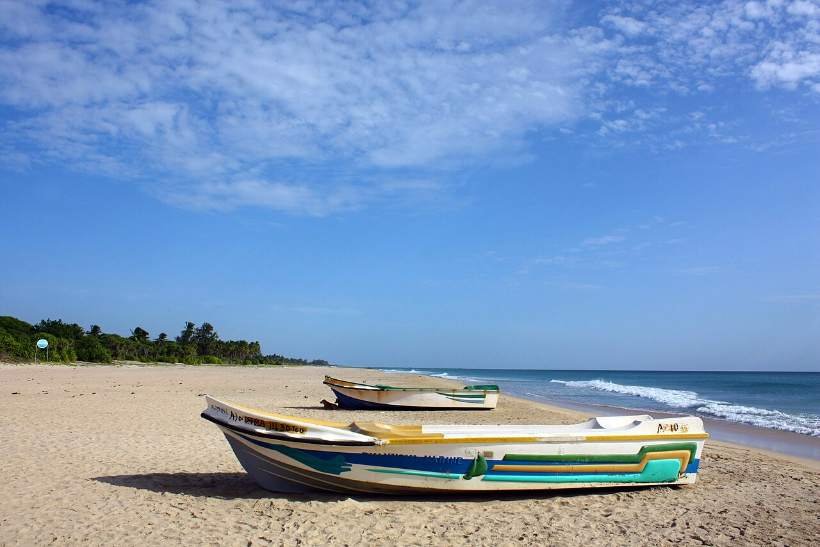 Nillaveli BeachPhoto: Anton 17 (CC BY-SA 4.0)
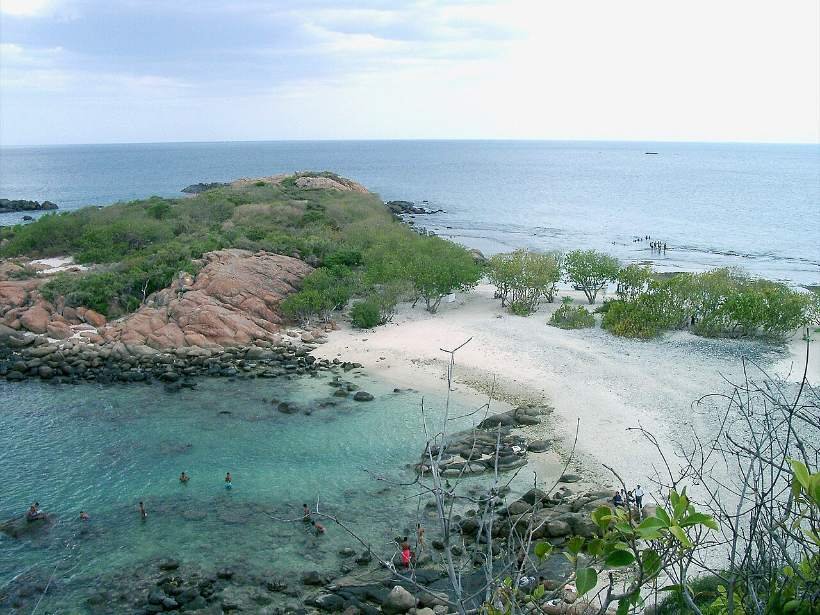 Sri Lanka Trincomalee Pigeon IslandPhoto: Dschen Reinecke (CC BY-SA 3.0)
What most visitors walk straight past
Blue whales and sperm whales, April to August, with the peak in July and August. Boats leave Uppuveli between 06:00 and 11:00. Sperm whales are the local advantage — they travel in pods of 5 to 20 and are encountered here far more often than off the south coast — and spinner dolphins are close to a certainty. These are precisely the months the southern season is over.
The fort is the temple. Carved pillars and dressed blocks taken from Koneswaram were reused in the 1624 walls. Look at the stonework as fabric rather than decoration and the whole sequence of 1622 to 1624 is standing in front of you.
Blacktip reef sharks in knee-deep water at Pigeon Island. Juveniles and adults both use the shallows. Hawksbill, green and olive ridley turtles all occur, and Acropora dominates the main reef.
Kanniya’s seven wells run at different temperatures despite sitting within a few metres of one another, are only about a metre deep, and empty after ten to fifteen buckets are drawn before refilling. The legend that Ravana struck the ground here to raise the springs for his mother’s funeral rites is told as legend; the archaeology on site is Buddhist, with a stupa mound and a 1st–2nd century CE inscription about monastic water reserves.
The Lover’s Leap story is a good lie. The 1687 pillar on the cliff edge is real; the tale that Francina van Reede threw herself off it when her betrothed sailed for Holland is not — the records show she remarried in 1694. Guides who tell both halves earn more credit than guides who tell one.
Velgam Vehera has sixteen Tamil inscriptions. A Buddhist monastery that the conquering Hindu Cholas renamed after their emperor and then funded, mostly with gifts of money and cattle to keep the oil lamps burning. It is the clearest surviving object lesson in this island’s religious history not running in a straight line.
Fort Fredrick’s spotted deer graze the fort road and the temple approach in the late afternoon and are wholly unbothered by people — the easiest wildlife photograph in Trincomalee.
The right hour is first light on Swami Rock, facing east over the harbour before the temple fills. Second best is dusk, when the fort deer come out and the harbour goes flat.
Where to stay in Trincomalee & Nilaveli
Trincomalee town has the harbour and the Koneswaram temple on the cliff but no beach worth swimming from, so stay north of it: Uppuveli at about three kilometres for the closest beach to town, or Nilaveli at about sixteen for quieter sand and the nearest access to Pigeon Island. The east coast season runs roughly May to September; outside it the sea is rough and much of the strip shuts.
- Uga Jungle Beach - TrincomaleeA small resort on a private reserve at Kuchchaveli, about half an hour north of Trincomalee, with rooms in the trees and several kilometres of empty beach. Average rates were roughly $215-460 in August 2026. It is genuinely remote, with few taxis passing and no alternative restaurants, so food and spa bills mount up; the dark sand also gets hot enough at midday to need shoes. Check dates and rates →
- Trinco Blu by CinnamonA large beachfront hotel on Uppuveli with a big pool, the most convenient base for the town, the harbour and diving trips. Average rates were about $120-490 in August 2026. Standard rooms and bathrooms are basic and dated even though the site is good, breakfast choice is narrow, and several guests report cleaning being missed on arrival. Check dates and rates →
- Nilaveli Beach HotelAn old hotel at the 11th mile post on Nilaveli beach, closest of the established places to the Pigeon Island boats, with wooden bungalows facing the sea. Average rates were roughly $80-295 in August 2026. It has been there fifty years and looks it, there is no wifi in the rooms, and several travellers feel it charges more than the state of the rooms justifies. The beach and the position are what you are buying. Check dates and rates →
We earn a small commission if you book through these links, at no extra cost to you. It costs you nothing and it does not change what we recommend — the notes above are what travellers actually report, not what pays best.
What do travellers actually say about Trincomalee & Nilaveli?
n = 231 traveller reports · public traveller forums · gathered August 2026
Trincomalee is the standard answer travellers give to the question “where do I go to escape the south coast?” — better prices, calmer behaviour, and beaches several people call the best on the island.
- Contradicts the guidebookThe whale-watching narrative points south to Mirissa. Travellers who have done both say the east is the better trip between March and August, because blue whales, sperm whales and dolphins come much closer to shore here.
- Season is the whole story. Roughly March or April to September is the window, and mid-July is repeatedly named as one of the best weeks of the year to be here — exactly when the south-west is in monsoon.
- Nilaveli and Uppuveli are where you actually stay; the town is a distance away, so a vehicle matters. Food near the beach is limited and expensive and some resorts are effectively the only dinner. Beachfront rooms at Nilaveli are reported at USD 50–70 a night.
- A safety warning we will repeatPigeon Island carries two: a fatal boat-propeller accident involving a snorkeller near the mooring area, with the advice to stay close to your guide, and long-running concern from Sri Lankans about reef damage at the site.
- Nightlife is quiet — a few restaurants and beach bars around Uppuveli and Nilaveli, generally winding down around 11pm or midnight in season.
- Worth knowing before you planDistance is the argument against it on a short trip. Sigiriya to Trincomalee is 2.5 to 3.5 hours and Trincomalee to Arugam Bay four to five. On a ten-night loop travellers are frequently told to swap in Pasikuda instead.
Where travellers disagree. Whether Trincomalee justifies the detour. People who come for the beach say yes without hesitation; people optimising a ten-day loop are often told to cut it. The tiebreaker in the reports we gathered is simple — swimming goes to Trincomalee and Nilaveli, surfing goes to Arugam Bay.
Questions people ask about Trincomalee & Nilaveli
Is Trincomalee better than Mirissa for whales?
Between March and August, travellers who have done both say yes, and the reason is distance from shore rather than raw numbers — the animals come closer in here. Sperm whales are the local advantage, travelling in pods of 5 to 20. Boats leave Uppuveli between 06:00 and 11:00, and the peak is July and August, when the southern season is already over.
How long do you need?
Three nights minimum. One day for Pigeon Island, one for whales plus Koneswaram and the fort, and one loose day for Kanniya, Velgam Vehera or Seruwila.
What does Pigeon Island actually cost?
Foreign adults are quoted USD 25 plus 18% tax and a vessel charge, and the boat is separate again — roughly LKR 15,000 for a six- to eight-seat boat from Nilaveli, often with a dolphin detour included. The park runs 06:00 to 18:00 with the ticket counter shutting at 16:00.
When can you dive?
The Nilaveli dive season is 15 March to 15 November, closing for the northeast monsoon from 16 November to 14 March. Best conditions are mid-April to the end of October, and the water sits at 26–30 °C all year.
Is there anything to be careful about?
Fort Fredrick is an active army camp with a resident detachment and the harbour is a naval facility — assume photography restrictions near military buildings and take the guard’s direction. Nilaveli and Uppuveli have no lifeguard cover. This coast has a war history within living memory: ask before photographing people, memorials or damaged buildings.