History of Tissamaharama
The reason this town exists is the great white stupa at the centre of it. It was raised to mark the place where the Buddha is held to have meditated with 500 arhants — enlightened monks. Worth being straight about where that comes from: Tissamaharama is the eighth of the Solosmasthana, the sixteen places Sri Lankan Buddhists venerate by name — but it is not among the ten sites in the Mahavamsa chapter that records the Buddha's three visits. Devotional tradition rather than chronicle: a different kind of claim, not a weaker one. At 156 feet high and 550 feet around it is the largest stupa in southern Sri Lanka, and among the largest anywhere in the country.
Inside it, according to the chronicles, is the frontal bone relic of the Buddha. A pillar inscription records that the left tooth relic was enshrined here too.
The town around it was the oldest capital of the south — seat of the Ruhuna kingdom from the 3rd century BCE, and the kingdom that held out when the north fell. The monastery here was the pre-eminent Buddhist teaching centre of southern Sri Lanka for fourteen hundred years, from the 3rd century BCE to the 11th century AD, holding over 18,000 acres of land at its height.
Two more things came out of the ground here that are worth knowing. Roman coins and Mediterranean pottery, which put this town on a trade route running to Rome and Southeast Asia. And a hospital from the 1st to 2nd century AD — the earliest ever found in South Asia.
This is also the birthplace of Dutugemunu, the king who went north and unified the island; his mother Viharamahadevi washed ashore here after being set adrift to appease the sea. But you do not need a single king's name to understand the place. You need to know that it is the oldest capital of the south, that it holds the biggest stupa down here, and that the stupa marks a spot where the Buddha is said to have sat.
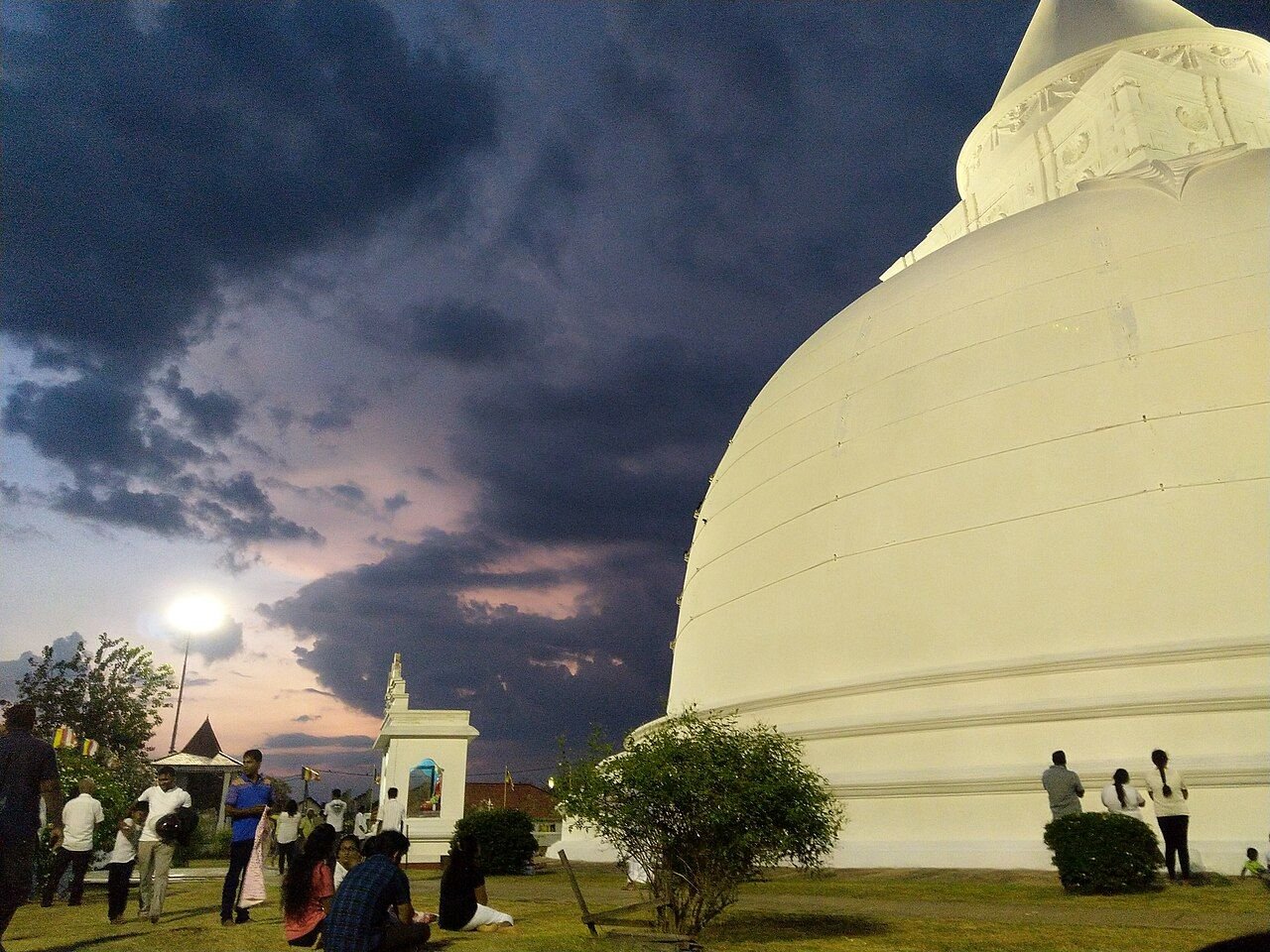 The stupa at dusk, with pilgrims at the foot of it for scale. 156 feet high and 550 feet around.Photo: KasunRajitha
What should you see in Tissamaharama?
- Tissamaharama Raja Maha ViharaThe great white stupa, and the reason the town exists. It was raised to commemorate the Buddha's visit — built on the spot where tradition holds he spent time in meditation with 500 arhants. At 156 feet high and 550 feet around it is the largest stupa in southern Sri Lanka and among the largest anywhere on the island.
- The relics inside itChronicles name the frontal bone relic of the Buddha as the principal one enshrined here. A pillar inscription records that the left tooth relic was also placed in this stupa — which, if you have been to Kandy, is worth sitting with for a moment.
- The monastery groundsThis was the pre-eminent Buddhist teaching centre of the south from the 3rd century BCE to the 11th century AD. Fourteen hundred years of unbroken scholarship. At its height in the 3rd to 5th centuries the monastery held over 18,000 acres of land.
- Yatala WeheraTwo kilometres away, from the same Kavantissa period, with an elephant-wall frieze and a moonstone worth the short detour. Quieter than the main temple and usually empty.
- Sandagiri StupaA third ancient stupa in the same cluster, restored from ruin. The three together tell you how much was here.
- Tissa WewaThe tank King Mahanaga built in the 3rd century BCE, around 550 acres. Its embankment of earth, clay and stone has held through two thousand years of monsoon and still irrigates the paddy today. Go at dusk for the birds and the light on the water.
- The Akurugoda excavation areaWhere the Roman coins and the ancient hospital came out of the ground. Not presented as a visitor site, but ask and your driver will show you where it is.
- DebarawewaThe neighbouring tank and village, where a good share of the town's guesthouses actually sit. Calmer than the main road.
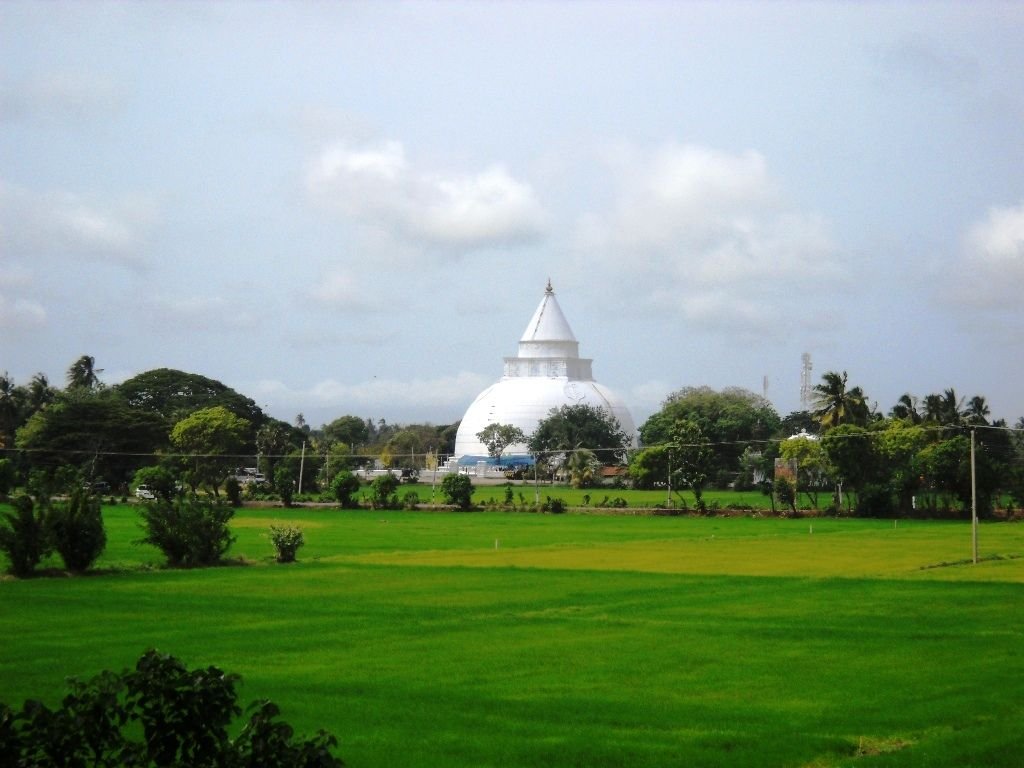 The white dome over the paddy. This is the view most visitors have of it — through a car window, on the way to a jeep.Photo: Shehanw
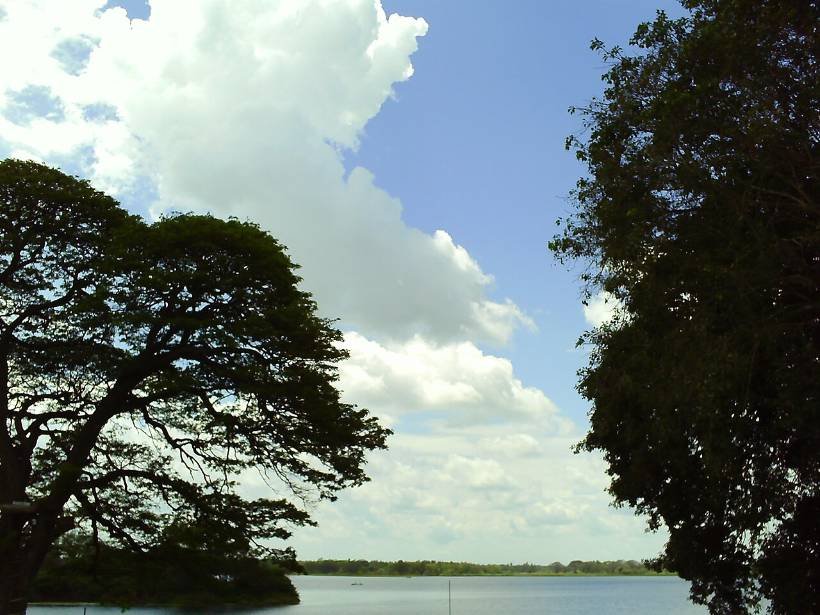 Tissa Wewa. The tank was dug in the 3rd century BCE and still waters the paddy today.Photo: Krankman
What most visitors walk straight past
The stupa is not there because a king wanted a monument. It marks a place — where the Buddha is held to have meditated with five hundred arhants. Every other fact about it, including its size, is downstream of that. Guides who lead with the dimensions have the story backwards.
Two kings are credited with it. Most accounts give the monastery to Kavantissa in the 2nd century BCE; some historians put the first construction under Mahanaga a century earlier. Both names are worth knowing, because the argument is really about how old Ruhuna is.
The tank is the older achievement. Tissa Wewa predates the stupa. A society that could move that much earth in the 3rd century BCE, and build an embankment still working today, was not a frontier settlement.
It fell and was raised again. The stupa stood ruined for centuries. Restoration began in 1858 under Wepathaira Sumana Thera, ran into the early twentieth century, and the last structural repairs were only finished in February 1998. What you photograph is a 2,100-year-old idea in fairly recent brick.
Go at dawn or at dusk. The white dome takes early and late light beautifully and the middle of the day is punishing. If you are on the 5am Yala run anyway, come back for the last hour of light instead of collapsing at the hotel.
It is a working temple, not a ruin. Shoes off, shoulders and knees covered, and step around rather than through anyone at prayer.
Why base yourself here
This is the practical hub of the deep south, and it is the real reason the town fills up. Yala's main gate is 20 km away. Bundala is 20 minutes. Kataragama is 18 km. Three national parks and a multi-faith pilgrimage city, all within half an hour of the same bed.
It is the one place on a southern itinerary where a second night genuinely pays. One night buys a Yala dawn drive and a departure. Two buys Yala, Bundala's flamingos, Kataragama's evening puja, and an unhurried hour at a stupa older than almost everything else you will see on this island.
Where to stay in Tissamaharama
Most guesthouses sit around Tissa Wewa and out at Debarawewa, which is quieter than the main road and no further from the Yala gate. Anything advertising a 4:30am safari breakfast is used to the routine.
- Hibiscus Garden HotelA mid-range garden hotel on the Tissa side, used to pre-dawn Yala departures and geared for it. Comfortable rather than characterful, and priced accordingly. Around USD 60-80 a night observed in August 2026. Check dates and rates →
We earn a small commission if you book through these links, at no extra cost to you. It costs you nothing and it does not change what we recommend — the notes above are what travellers actually report, not what pays best.
What do travellers actually say about Tissamaharama?
n = 31 traveller reports · public traveller forums · gathered August 2026
Thirty-one traveller reports mention Tissamaharama and almost every one of them treats it as a location rather than a place. This is the clearest example in the whole corpus of a town nobody looks at.
- Contradicts the guidebookThe word travellers use is a direction, not a destination: they "drove to Tissamaharama, where the main gate to Yala is located." In thirty-one mentions, the largest stupa in southern Sri Lanka does not come up once.
- Every itinerary uses it the same way: arrive late afternoon, sleep, 4:30am jeep, leave. The town gets roughly eleven waking hours and most of them in the dark.
- Travellers do report the people here warmly. One group specifically named Tissa and Yala as places they were treated well, in a thread about being treated badly elsewhere on the coast.
- Guesthouses are geared to the safari clock, with early breakfasts as standard. That is a genuine convenience and it is the main thing people praise.
- Nobody mentions Tissa Wewa, Yatala Wehera or Sandagiri. The tank appears in photographs without being named.
Where travellers disagree. There is no disagreement to report, which is itself the finding. Travellers are not split about Tissamaharama; they simply have not looked at it. The one night versus two nights question has not been asked because almost everybody assumes one.
Questions people ask about Tissamaharama
Why was the Tissamaharama stupa built?
To commemorate the Buddha's visit to the area. Tradition holds it stands on the spot where he spent time in meditation with 500 arhants. It was raised under King Kavantissa in the 2nd century BCE, though some historians credit the first construction to King Mahanaga a century earlier.
How big is it?
156 feet high and 550 feet in circumference — the largest stupa in southern Sri Lanka, and among the largest on the island. It is also the reason the town has its name: maha means great.
What is enshrined in it?
Chronicles name the frontal bone relic of the Buddha. A pillar inscription additionally records the left tooth relic as enshrined here.
Is Tissamaharama worth stopping for, or just for Yala?
It is worth an hour on a morning you are here anyway, and it costs nothing. You are standing in the capital of the Ruhuna kingdom, on ground that produced Dutugemunu, beside a tank built in the 3rd century BCE that still waters the fields. Most people photograph the stupa from the road on the way to a jeep.
How many nights should you give it?
Two, if the south is on your route. One night buys a Yala dawn drive and a departure. Two buys Yala, Bundala twenty minutes away, Kataragama eighteen kilometres up the road, and the stupa in evening light.