History of Yala
Yala was declared a wildlife sanctuary under the Forest Ordinance in 1900 and became a national park on 1 March 1938, when the Flora and Fauna Protection Ordinance was passed. It now covers 978.807 km², built up in five blocks added over thirty-five years: Block I, 14,101 ha in 1938; Block II, 9,931 ha in 1954; Block III, 40,775 ha in 1967; Block IV, 26,418 ha in 1969; Block V, 6,656 ha in 1973. Mean annual rainfall is 500–775 mm and temperatures run from 26.4 °C in January to 30 °C in April, so surface water becomes the limiting resource in the dry season and decides where the animals are.
The land was inhabited long before it was a park. Sithulpawwa — Chittalapabbata in the chronicles — is attributed to King Kavantissa and is said to have housed 12,000 arahants; the Mahavamsa credits King Vasaba with ten stupas there, Mahallaka Naga (134–146 CE) with more, and records a land donation by Dappula of Rohana in 659 CE. A cave temple holds paintings assigned to the 3rd century BC. Magul Maha Viharaya nearby is dated to 87 BC by one source and to the 2nd century BC by a 2015 excavation, with a brick Bodhigharaya 35 × 18 m and red-and-black ware begging-bowl shards carrying Brahmi inscriptions; the Akasa Chaitiya on the Sithulpawwa summit is 2nd century BC. In all, 39 archaeological sites are recorded inside the park, and Yala receives around 400,000 pilgrims a year.
On 26 December 2004 a wave recorded at 6.1 m — with a maximum run-up of 12.5 m measured at Yala, the highest recorded in the country — killed 250 people in the park’s vicinity and affected about 5,000 ha of grassland, forest and wetland.
The park’s headline animal is the Sri Lankan leopard, Panthera pardus kotiya, described by P. E. P. Deraniyagala in 1956 and listed Vulnerable by the IUCN since 2020, with fewer than 800 mature individuals island-wide. A 2001–02 study put adult resident density in Block I at 12.1 mature individuals and 21.7 individuals of all ages per 100 km²; a 1982 estimate gave 25 individuals in Block I. Current numbers in the block are not settled by anything we could check.
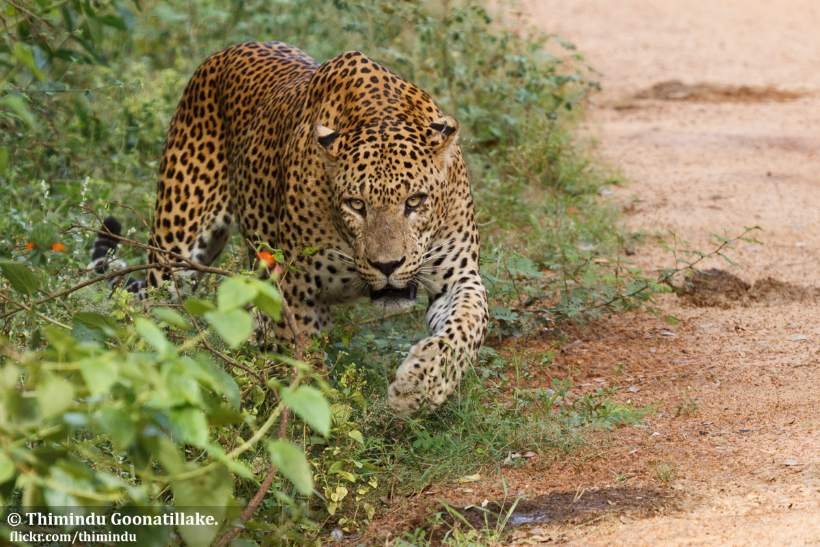 Sri Lankan Leopard Yala National ParkPhoto: Thimindu Goonatillake from Denver, USA (CC BY-SA 2.0)
Which block, which gate, and what is in them?
- Block I (14,101 ha, 1938)The classic game-viewing block, entered at Palatupana, holding the leopard density that made Yala’s reputation. Roughly 200 vehicles a day pass that gate. Open in normal years — but see the closure note below.
- Block II (9,931 ha, 1954)Adjoins Block I to the east. Open in normal years, and closing alongside Block I from 14 September 2026.
- Blocks III and IV (40,775 ha, 1967, and 26,418 ha, 1969)The park’s interior and its largest ground by far, lightly visited. No source we could fetch states whether they are open to general visitors at all, so treat them as unconfirmed rather than as an option.
- Block V (6,656 ha, 1973)Entered at Galge, which restricts traffic to two or three vehicles per safari. This is the block to choose if you want Yala without the convoy, and it is confirmed as having a public entrance.
- Palatupana entranceThe main gate for Block I and the busiest point in the park at about 200 vehicles a day. It is the default, and the default is the problem.
- Katagamuwa entranceThe quiet gate, admitting about 20–30 vehicles a day, thirty minutes from Kataragama and forty-five from Tissamaharama — and it reaches the same Block I ground.
- Sithulpawwa Rajamaha ViharayaThe rock monastery inside the park, 20 km from Kataragama by the Kataragama–Sithulpawwa road, about forty-five minutes. The Akasa Chaitiya, a 2nd-century BC stupa, sits on the rock summit.
- Magul Maha ViharayaAbout 12.5 km from Kirinda on the Kirinda–Sithulpawwa road: the Bodhigharaya foundations, three stupas, rock pillars and the inscribed pottery. Its founding date is contested at 87 BC, the 2nd century BC or the 1st century BC.
- Kumana National ParkThe former Yala East, renamed in 2006 — 35,664 ha adjacent to Yala, a Ramsar wetland since 29 October 2010, closed from 1985 to March 2003 because of the war, with 255 recorded bird species. Its villu, a mangrove swamp dominated by Sonneratia caseolaris, is one of the country’s most important bird breeding grounds.
- Sithulpawwa, the hill of the quiet mindA 2nd-century BC rock monastery inside the park boundary, 18 km east of Kataragama, its name meaning the hill of the quiet mind. Anuradhapura-era paintings survive, along with ruined image houses and circular relic houses scattered through the site, and a stupa on top of the rock. Almost nobody on a leopard drive asks to stop.
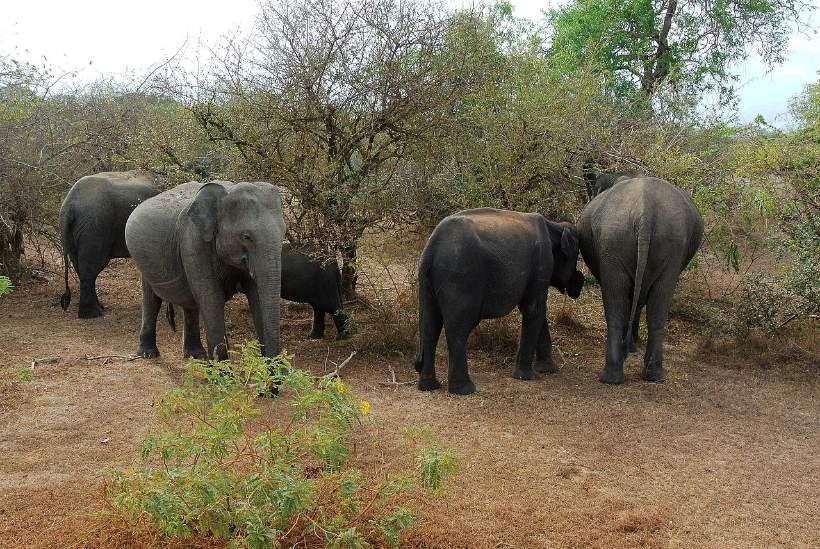 Elephant Herd Yala National ParkPhoto: Adbar (CC BY-SA 3.0)
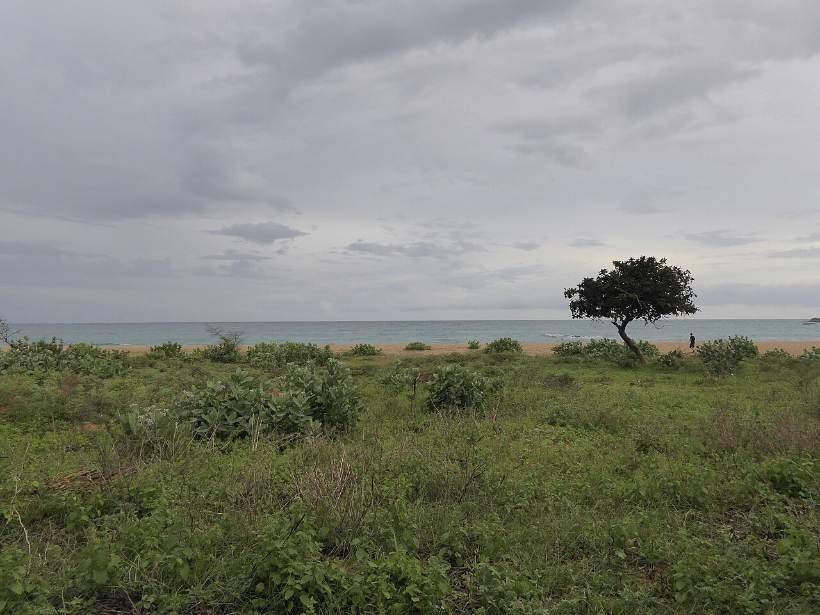 Sri Lanka Photo178Photo: psychoslave (CC BY-SA 4.0)
What should a naturalist tell you before the jeep starts?
Sri Lankan leopards do not hoist their kills into trees, and there is a reason. With no lion, tiger or comparably sized competitor on the island, the leopard is the apex predator and has no need to cache carcasses out of reach. It has also grown larger than most leopard populations: males average 56 kg, with a recorded maximum of 77 kg, a body length of 1.42 m and a 97 cm tail. Point out an unhoisted kill and you have explained an entire island’s ecology in one sentence.
The density figure, framed honestly. Block I’s 12.1 adult residents per 100 km² is among the highest leopard densities recorded anywhere — which is exactly why the vehicles come, and why the sighting is still not guaranteed. Dawn and dusk are the productive windows.
Choose your gate to choose your day. Palatupana takes about 200 vehicles a day. Katagamuwa takes 20–30 and reaches the same Block I ground. Galge admits two or three per safari into Block V. That single decision does more for the quality of a Yala day than anything else within your control.
A protocol to insist on. Stay in the vehicle except at designated stops, no baiting, no calling, no blocking an animal’s line of travel — and refuse a driver who races another jeep to a sighting. The Block I convoy is caused by exactly that behaviour, and the only vote you have is which driver you are sitting behind.
This is a pilgrimage landscape as much as a game park. Around 400,000 pilgrims a year come to Yala, mostly for Sithulpawwa, and there are 39 archaeological sites inside the boundary. A safari that treats the place purely as wildlife is missing half of it.
Sithulpawwa’s numbers, and Magul Maha Viharaya’s crockery. A monastery said to have held 12,000 arahants, cave paintings assigned to the 3rd century BC, and a stupa on the summit from the 2nd century BC — all inside a national park and on a normal safari route from Kataragama. Excavation at Magul Maha Viharaya produced red and black ware bowl shards with Brahmi inscriptions cut into them: the monks’ named crockery, 2,200 years old.
The 2004 wave reached 12.5 m here, the highest run-up recorded anywhere in the country. Two hundred and fifty people died in the park’s vicinity and 5,000 ha of habitat were hit. The coastal stretch of Block I is where that conversation belongs, and it should be brief.
The rest of the list. Two hundred and fifteen bird species, seven of them endemic, plus 44 mammals, 47 reptiles with six endemics and 21 freshwater fish. Sloth bears and elephants are both present and both dangerous on foot, which is the real reason you do not get out.
The Pada Yatra walks through here. The foot pilgrimage from Jaffna to Kataragama comes down the east coast through Kumana and Yala, and both Tamil and Sinhalese communities take part. If you are in the park in late June or July you may cross its path.
Where to stay in Yala National Park
There are two bases and they suit different trips. Palatupana, at the park gate, cuts the pre-dawn drive to almost nothing but leaves you eating every meal at your hotel; Tissamaharama, about 45 minutes away, has a lake, a town, restaurants and much cheaper rooms. For a single morning safari, Tissa is the sensible choice.
- Wild Coast Tented Lodge - Relais and Chateaux - All InclusiveTwenty-eight tented cocoons on a wild stretch of beach at Palatupana, on the boundary of the park, with a main pavilion built to echo the boulders around it. Average rates were roughly $1,120-2,500 a night in August 2026, all-inclusive with safaris. It is the most expensive room in this whole list and the only real criticism travellers raise is the price; if the budget is there, nothing else in Yala is close. Check dates and rates →
- Cinnamon Wild YalaChalets between jungle and beach a few minutes from the park entrance, where elephants and buffalo wander the grounds and staff walk you back to your room after dark. Average rates were about $215-350 in August 2026. It is an older property and the pool and some fittings show it, the open-sided restaurant is hot at midday, and with no other food within reach you are captive to hotel prices. Check dates and rates →
- Hibiscus Garden HotelA quiet garden hotel at Mahasenpura on the edge of Tissamaharama, the last building before the paddy fields, with good birdlife and a pool, about 45 minutes from the park gate. Average rates were roughly $88-90 in August 2026. Some rooms are tired, the wifi barely reaches them, and you need the car if you want to eat anywhere else. Check dates and rates →
We earn a small commission if you book through these links, at no extra cost to you. It costs you nothing and it does not change what we recommend — the notes above are what travellers actually report, not what pays best.
What do travellers actually say about Yala National Park?
n = 291 traveller reports · public traveller forums · gathered August 2026
Yala’s crowding is not a matter of opinion in the reports we gathered — it is the dominant fact about the park. The useful part of the material is not the complaint but the workaround, which is specific and entirely actionable.
- Contradicts the guidebookAround 500 jeeps already operate in the park. Operators asked to add 175 more and the wildlife department refused, on the grounds that Yala has already exceeded sustainable capacity. Travellers describe vehicle jams lasting more than an hour around a single animal.
- The fix, stated specificallyAvoid Block 1, use Blocks 5 and 6, and enter through Katagamuwa rather than Palatupana. Katagamuwa still reaches Block 1 with far fewer vehicles; the outer blocks are quieter again and still hold leopards, elephants, buffalo, bears and exceptional birdlife. Note that the official record documents five gazetted blocks with three confirmed public entrances, so treat block numbering in traveller accounts as local usage rather than an official map.
- The ethical cruxGuides are incentivised on leopard sightings, and travellers describe jeeps racing one another and visibly stressing elephants. The counter-example repeatedly recommended is a property with an in-house naturalist who books the safari, rather than a jeep taken at the gate.
- Yala is not empty of merit. A returning visitor who had done South Africa found the density and the lake-and-scrub landscape genuinely impressive, with very large deer herds at sunset and peacocks throughout. The complaint is about vehicle numbers, not about the animals.
- PracticalGates run 06.00–18.00 and you must enter in a safari jeep; self-driving is not permitted, and a half-day morning is the standard session. Tissamaharama is the base for the main gate and has far more accommodation; Kataragama and Sella Kataragama serve Katagamuwa.
- WeatherAfter heavy rain the approach from the Gal Oya side turns into flood-plain driving and the park itself becomes a mud experience. That is a four-wheel-drive argument, not a cancellation argument.
Where travellers disagree. Whether to include Yala at all. A substantial minority of residents say to skip it and go to Kumana or Wilpattu instead. Others say it still gives the best single-park odds for a leopard, and that the crowding is manageable with the right gate and the right block. Both positions come from people who have been.
Questions people ask about Yala National Park
Is Yala too crowded to be worth it?
It depends entirely on how you enter. Around 500 jeeps operate in the park and travellers describe hour-long vehicle jams around a single leopard, which is the honest headline. But Palatupana takes about 200 vehicles a day, Katagamuwa takes 20–30 and reaches the same ground, and Galge admits two or three per safari into Block V. If you cannot get the quiet gate, Udawalawe for elephants or Wilpattu and Kumana for a leopard park without the convoy are the substitutes residents themselves name.
Which gate should you use?
Katagamuwa if you want Block I without the traffic — thirty minutes from Kataragama, forty-five from Tissamaharama, and about 20–30 vehicles a day against Palatupana’s 200. Galge if you want Block V, where entry is restricted to two or three vehicles per safari. Palatupana is the default and the default is the problem.
What does Yala cost?
There is no single number, and anyone quoting one is quoting a component. The structure is a per-person park fee, plus a per-vehicle service charge, plus a vehicle permit, plus VAT, with the jeep separate again. A 2025 source gives USD 25 for a foreign adult, USD 15 for children 6–12 and a LKR 300 vehicle charge, plus 18% tax; a 2026 operator breakdown gives USD 42–45 per foreign adult inclusive of 15% VAT and service fees, with a jeep at USD 40–55 for a half day or USD 60–85 for a full day. The two do not reconcile, and the VAT rate itself differs between them.
Is the park closing?
Blocks 1 and 2 close to visitors from 14 September 2026, for ecological recovery — the stated reason is that uninterrupted human presence disrupts animal behaviour, breeding and vegetation regeneration. No reopening date was published in the announcement, and other zones remain available. A September-into-October closure of Block I for rejuvenation is the normal annual pattern anyway, so September is the month to avoid. Check before you book.
How many safaris do you need?
One four-hour session is the minimum; two — an afternoon and the following morning — materially improve the leopard odds, because dawn and dusk are the productive windows. Add half a day if you want to do Sithulpawwa properly, which is 20 km and about forty-five minutes from Kataragama inside the park.