Why are the blue whales here at all?
Mirissa lies on the south coast in Matara District, about 150 km south of Colombo at 4 m elevation, with a recorded population of 81,740. It is the largest fishing port on the south coast, landing tuna, mullet, snapper and butterfish. The first tourist accommodation opened in 1980 and the town’s tourism grew from the mid-1990s. The 2004 tsunami destroyed or damaged homes, guesthouses, shops, schools and temples here, with fourteen deaths reported — far fewer than at Weligama or Galle.
The whale-watching industry that now defines the town rests on a piece of oceanography. The continental shelf margin between Dondra Head and Galle, with its submarine canyons, is a highly productive upwelling zone, and blue whale aggregations concentrate near the 1,000 m isobath only a short run offshore — closer to land than at almost any other blue whale site in the world. A 2015 study out of Mirissa logged 729 individual whales over 177 successful sighting days, with an overall trip success rate of 68.7% and encounter peaks in April, at about fifteen sightings a day, and December, at about twenty. Sightings are elevated from November through April.
The same paper’s conclusion is the most interesting fact about the place: these animals are best understood as a year-round resident Indian Ocean population rather than long-distance migrants. Guests arrive expecting a migration and are getting a permanent address instead.
The regulatory framework is the Sea Mammals (Observation, Regulation and Control) Regulations, No. 1 of 2012. Compliance has been the problem, not the rules: research in 2012–13 documented vessels approaching too fast, too close and too unpredictably, correlated with shifts in whale distribution and increased strandings, and a 2016 study found monitoring and enforcement weak. Roughly 40,000–50,000 vessels a year transit this stretch on the east–west shipping route, overlapping directly with the aggregations, which makes ship strike the other standing risk.
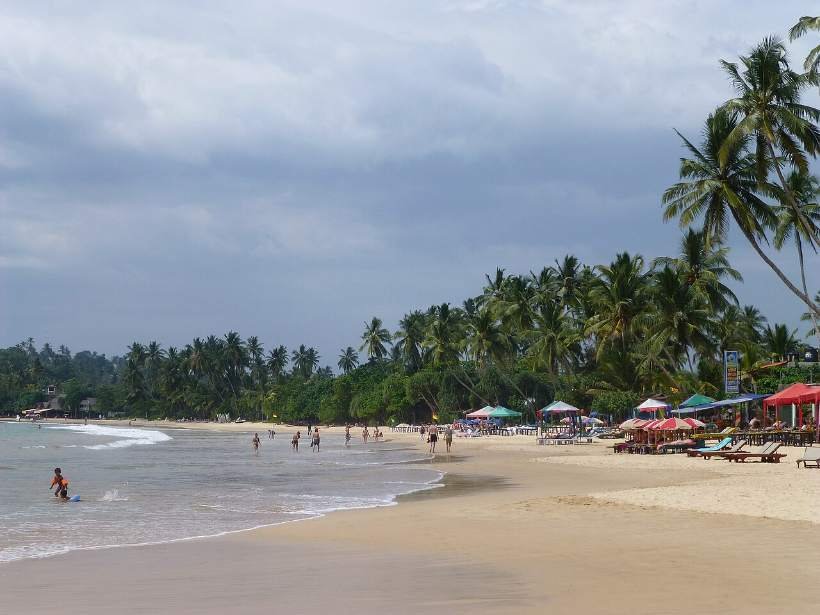 Mirissa PlagePhoto: Ji-Elle (CC BY-SA 3.0)
What is worth your time around Mirissa
- Mirissa Fisheries HarbourWhere the whale boats leave from, and worth twenty minutes in its own right for the painted boats and the morning landings. Departures are around 06.30, with hotel pickups from about 06.00.
- Mirissa BeachOver a kilometre of sand, the main bay and the default sunset spot — and the part of town the arguments below are actually about.
- Parrot Rock (Giragala)A rock about 15 m off the beach with a rickety stair to the top. Easy to walk out to at low tide and genuinely treacherous at high tide, which is where people get hurt. Check the tide before you climb, not after.
- Coconut Tree HillThe palm-covered headland east of the bay. Go at sunrise: it faces the wrong way for sunset and is packed by mid-morning. The central tree lost its crown in a recent storm, so the postcard shot no longer exists.
- Secret BeachAn 800 m walk from parking on Harbour Road, sheltered by rocks to the point of being effectively a rock pool. The calm-water option when the main bay is working.
- Turtle Beach and Turtle PointGreen turtles feed off the headland and are regularly seen from shore. The current here runs strong — give the animals space in the water, and do not chase or touch them.
- Sri Sunandarama TempleThe town temple, and the part of Mirissa that has nothing to do with the strip.
- Dondra HeadThe headland east of town that anchors the shelf edge where the whales concentrate. It is the reason the boats only run a short way out.
- Weligama and Mirissa PointThe neighbouring bay ten to fifteen minutes west, for beginner surf; Mirissa Point at its eastern end is the rocky-entry break that eats boards.
How do you pick a whale boat, and what should it do?
Know the approach rules before you board. Under the 2012 regulations a vessel must reduce speed gradually from 400 m out, must not change speed or direction abruptly, must not position itself in front of, behind or across an animal’s route, must not use food, light or sound to attract, must stay 100 m from a whale with the engine off at that distance, and 50 m from other marine mammals. A boat that breaks those rules in front of paying passengers who know them is a boat that loses its reputation.
Say plainly that the fleet misbehaves. Reporting on Mirissa describes ten to twenty-five boats converging on the same blue whale in peak season, captains radioing sightings to one another and racing to arrive first, and approaches inside 30–50 m against a 100 m legal minimum. Researchers have recorded elevated stress indicators in the whales during peak tourist season.
What a good operator does. Briefs distances before departure. Caps itself at a handful of boats on a sighting. Cuts to slow speed around 500 m and kills the engine at 100 m. Runs a fifteen to thirty passenger boat rather than a barge. Does not advertise guaranteed sightings. Genuinely responsible operators charge roughly 30–50% above the mass-market boats, and that premium is the filter — it is the most reliable signal available, because prices are not published anywhere consistently.
Set the odds honestly. A 68.7% success rate across a full year of trips is a good number for wild cetaceans and a bad number to present as a certainty.
Ship strike is the bigger threat, not the tour boats. Between 40,000 and 50,000 vessels a year cross the same water the whales feed in. A guest who asks whether whale watching is bad for the animals deserves that comparison alongside the honest answer about the fleet.
What you may actually see. Blue whales primarily, with Bryde’s and sperm whales opportunistically and spinner dolphins alongside; fin whales are also reported off Mirissa. Sperm whale aggregations occur in March. The blue whale window here runs October or November to March or April, with a secondary August–October window reported locally; Trincomalee, on the other coast, runs March to July.
Six hours on open ocean in a small boat. Take motion-sickness medication in advance if you are prone to it — once you are out past the harbour wall it is too late to start.
The two land-side hazards are the high-tide crossing at Parrot Rock and the current off Turtle Point. This is not a walk-in-anywhere coast.
Where to stay in Mirissa
Mirissa's own beach is short, crowded and backed by bars that run late, so light sleepers should not book on it. The calmer properties lie west toward Kamburugamuwa, but they are three to four kilometres out and you will use the car for every meal; the inland places sit above the coast road on steep, narrow lanes.
- Mount Cinnamon MirissaA small guest house on a working cinnamon estate on Henwalle Road, in the hills behind the coast, and the most interesting thing to stay in around Mirissa. Average rates were roughly $75-115 in August 2026. Two honest warnings: the access track is steep enough that tuk-tuks and some cars struggle with it, and guests report small rooms and bathrooms and occasional hot-water failures. You are here for the estate and the quiet, not the beach. Check dates and rates →
- Sri Sharavi Beach Villas & SpaA villa hotel at Kamburugamuwa on its own stretch of sand, built around a 43-metre saltwater pool. Average rates were about $225-450 in August 2026. The surf here is strong and you have to wade a long way out to swim properly, so the pool does most of the work; guests also flag that restaurant and spa bills carry 15-20% in added charges on top. Check dates and rates →
- Ubuntu Beach Villas by RevealA beachfront villa property on Galle Road at Kamburugamuwa, about four kilometres from Mirissa beach, with pools and direct access to a quiet shore. Average rates ran roughly $210-260 in August 2026. It is not walkable to Mirissa town, which is either the point or the problem depending on your plans, and the undertow makes sea swimming unwise. Check dates and rates →
We earn a small commission if you book through these links, at no extra cost to you. It costs you nothing and it does not change what we recommend — the notes above are what travellers actually report, not what pays best.
What do travellers actually say about Mirissa?
n = 463 traveller reports · public traveller forums · gathered August 2026
Mirissa is one of the most discussed places on this coast and one of the least admired in the reports we gathered. The whales hold up. The town is where the argument is.
- Contradicts the guidebookMirissa is sold everywhere as the whale-watching capital and the south’s best beach. The most common verdict from experienced travellers is a shrug: Ahangama and Hiriketiya get named for better cafés, better food and better sand, and Trincomalee gets named as the better whale trip because the animals come closer to shore there between March and August.
- The “algorithm version of Sri Lanka” complaint centres here — house music on the beach, expensive smoothie bowls, influencer scenes, crowded surf lineups. The people writing it are not budget backpackers; they are asking for plastic-chair seafood places and fishermen, and being pointed north and east.
- Worth knowing before you arriveMirissa is named in the same public notice from a local vehicle owners’ association as Weligama, Ahangama and Unawatuna — airport and Colombo drivers told to drop off and leave, and pickups booked through the ride-hailing apps obstructed along the strip. There is also a signage campaign here against foreign surf instructors.
- Concrete price dataA restaurant charged 500 rupees for a water bottle marked at 100 and told the customer it was normal down south. Charging above the marked retail price is contestable under Sri Lankan consumer law.
- A briefing issue for South Asian guestsThere is a documented incident of an Indian visitor refused a table at a beach shack, with shifting explanations ending in an admission that the venue wanted Western tourists. Comparable reports exist at Hiriketiya and at tea estates, and it is a real briefing point rather than an isolated bad evening.
- What still works, on the same reports: Coconut Tree Hill, Parrot Rock, Secret Beach and an early whale trip. The boats leave at dawn, which is a private-vehicle job rather than a bus one. Solo travellers name Mirissa as the place they deliberately avoided, because it is set up for groups and for partying.
Where travellers disagree. Whether Mirissa is a party town or a family beach. Both descriptions come from visitors in the same year, and the honest answer appears to be that the strip is one thing and the wider bay another.
Questions people ask about Mirissa
When is the best time to see blue whales off Mirissa?
Sightings are elevated from November through April, with recorded peaks in December, at about twenty sightings a day, and April, at about fifteen. Sperm whale aggregations occur in March. Across a full year of records the trip success rate was 68.7%. If your dates fall between March and August, Trincomalee on the east coast is the better trip — the animals come closer to shore there.
How do you choose a whale-watching boat?
By what the operator says before you pay. It should brief the approach distances, cap itself at a handful of boats on a sighting, cut to slow speed around 500 m and kill the engine at 100 m, carry fifteen to thirty passengers rather than a hundred, and refuse to promise a sighting. Responsible operators charge roughly 30–50% more than the mass-market boats, and that gap is the most reliable filter available.
How long is a whale trip, and how rough is it?
Boats leave the harbour around 06.30, with hotel pickups from about 06.00, and trips typically run about six hours. That is six hours on open ocean in a small boat. Take motion-sickness medication before you board if you are prone to it.
Is whale watching bad for the whales?
The fleet’s behaviour is documented and it is not good — boats converging on one animal, racing to arrive first, approaching inside 30–50 m against a 100 m legal minimum, and elevated stress indicators recorded in peak season. But 40,000 to 50,000 vessels a year cross the same water on the shipping route, so ship strike is the larger threat. The lever you actually hold is which boat you get on.
Is Mirissa worth staying in?
For the whales and an early start, yes. For the beach and the food, the reports we gathered send people elsewhere: Ahangama and Hiriketiya for cafés and sand, Weligama for surf, Tangalle for quiet. The strip and the wider bay are genuinely two different places, and which one you book decides your week.