History of Galle Fort
Galle’s pre-European record is thin and partly speculative. The colonial secretary James Emerson Tennent argued it was the biblical Tarshish from which Solomon drew ivory and peacocks; Ptolemy may have known the port as Odoka; Ibn Battuta landed in 1342 and called it Qali. The first hard artefact is the Galle Trilingual Inscription, dated 15 February 1409 and associated with Zheng He’s third voyage — a stone tablet 144.78 × 76.2 cm carrying three texts that are not translations of one another. The Chinese praises the Buddha, the Persian addresses Allah, the Tamil addresses Tenavarai Nayanar, a form of Vishnu, and each records the same offerings: 1,000 gold pieces, 5,000 silver, fifty rolls each of embroidered silk and taffeta, incense burners and 2,500 catties of scented oil. It was found face-down as a culvert cover near Cripps Road in early 1911 by the engineer S. H. Thomlin, and is now in Colombo.
A small Portuguese fleet under Lourenço de Almeida arrived in 1502 and the Portuguese built a fort in 1588. The Dutch East India Company took the town in 1640 — the landing was at Unawatuna, and the surviving Portuguese surrendered after a march on Galle and a four-day siege. The Dutch fortified from 1649, built most of the ramparts in 1663 including the Sun, Moon and Star bastions, completed the oldest gate in 1669 and the sea wall by 1729. The British took over in 1796 and, unusually, preserved the fort essentially unchanged and used it as the administrative centre, adding the Main Gate in 1873 and the clock tower in 1882.
UNESCO inscribed the Old Town of Galle and its Fortifications in 1988 under criterion (iv), reference 451, as the best surviving example of a European fortified city in South Asia.
On 26 December 2004 the tsunami devastated the city and killed thousands within it. The Maritime Museum flooded to 2.2 m and lost roughly 80% of its 3,600 salvaged shipwreck artefacts; the international stadium was wrecked, and test cricket did not return until 18 December 2007.
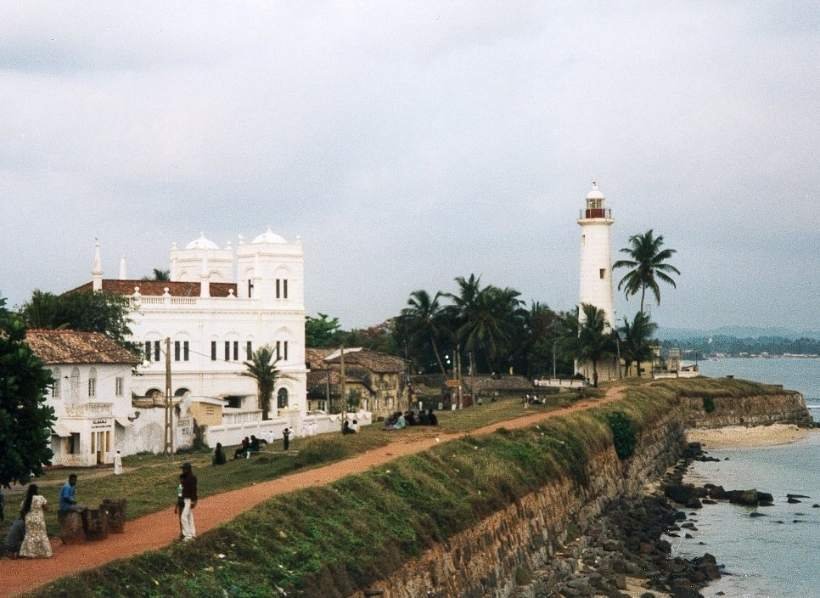 Srilanka galle fortPhoto: No machine-readable author provided. Krankman assumed (based on copyright claims). (CC BY-SA 2.5)
What should you actually see inside the walls?
- The rampart circuitThe fort covers 52 ha and has fourteen named bastions — Sun, Moon, Star, Zwart (the oldest), Akersloot, Aurora, Point Utrecht, Triton, Neptune, Clippenburg, Flagrock, Aeolus, Fishmark and Commandment. Free, 60–90 minutes at a stroll. The Old Gate of 1669 is the Dutch one; the Main Gate of 1873 is the only breach in the land wall and was cut by the British. Flag Rock at the southern tip is the best single viewpoint.
- Galle Lighthouse, Point Utrecht BastionThe present 26.5 m concrete tower went up about 100 m from the site of the 1848 cast-iron original — 24.4 m, designed by Alexander Gordon and imported from England — which burned in July 1936. Sources give the replacement as 1938 or 1939; the dedicated account says 1939 and we use that with the caveat attached.
- Groote Kerk, Church StreetThe Dutch Reformed church: foundations laid 1682, inaugurated 1755, funded by Casparus de Jong and Geertruyda Adriana Le Grand in thanksgiving for the long-awaited birth of a daughter. Belfry 1701, bell cast 1709, a second-hand organ brought from Colombo in 1760, stained glass around 1830. Undamaged by the tsunami, re-inaugurated on 28 November 2004 after a Dutch-funded restoration, and awarded a UNESCO Asia-Pacific Heritage Award in 2005.
- Meeran Jumma MosqueCommissioned in 1904 by Ahamed Haji Ismail — a Victorian and Baroque body with Islamic detailing, standing on what is reported to be the site of a Portuguese Catholic church, which is why it reads as a church at first glance. The wall carries the year 1325 Hijri, and a mosque of the 1750s is thought to have preceded it. Named for Meeran Saheb, a patron saint of sailors, buried at Nagore in India.
- National Museum of GalleA single-storey colonnaded Dutch building of 1656, originally the commissariat store, opened as a museum on 31 March 1986. Galleries cover Beeralu lace, mask carving and the historic turtle-shell jewellery trade, Dutch furniture and weaponry, and a Sri Lanka–China Friendship Gallery opened on 10 September 2013 covering Faxian and Zheng He. Open 9.00–17.00, Tuesday to Saturday.
- National Maritime MuseumIn a late-17th-century Dutch warehouse of 1671, rebuilt 1717, by the Old Gate. Opened 9 May 1992, gutted by the 2004 tsunami, reconstructed with a Rs 177 million Netherlands grant and reopened as the country’s first National Maritime Archaeology Museum on 4 March 2010. Material from some twenty wreck sites around Galle, a few pieces close to 800 years old. Allow 45 minutes.
- Old Dutch HospitalA 17th-century VOC hospital built over a former Portuguese mint, between the Zwart Fort and the Aurora bastion. Extended by the British after February 1796, barracks from 1850, the Government Agent’s office to 1948, Town Hall 1948–2003, conserved 2006–11 and reopened as a shopping and dining precinct on 20 September 2014. Coral-stone masonry, 50 cm walls, teak beams, open verandahs.
- Rumassala, Jungle Beach and the Peace PagodaThe headland closing the eastern side of Galle harbour, about 7.5 km from the fort. Jungle Beach is a small sheltered cove reached by climbing over Rumassala and dropping through scrub, with coral and reef fish offshore. The pagoda on the crest was built by monks of the Nipponzan-Myōhōji order, founded by Nichidatsu Fujii (1885–1985) after he met Gandhi in 1931, which had built about eighty pagodas worldwide by 2000. Its completion date is not confirmed.
- Martin Wickramasinghe Folk Museum, KoggalaThe novelist’s ancestral house and the museum established around it in 1981, run by the trust set up after his death in 1976. Allow an hour, and combine it with Koggala Lake — in the Second World War Koggala was the largest flying-boat base in the eastern world, and the 13th-century Kataluva Purvarama temple is nearby.
What most visitors walk straight past
The drains still work, and the sea cleans them. UNESCO’s own citation singles out a 17th-century underground drainage system still in use, flushed twice a day by tidal seawater entering through the wall. It is the detail that turns a pretty Dutch town into an engineered colonial port.
The ramparts are coral as much as granite. The Dutch built with both and shaped the wall to the rock beneath it rather than imposing a textbook European trace. UNESCO cites exactly that adaptation as the reason for inscription under criterion (iv).
Read the houses, not only the walls. The Dutch grid gives each house a narrow street frontage and a deep plan behind it, with a shaded veranda at the front — a South Asian answer to a European plan, and the reason the streets are still usable at two in the afternoon.
Zheng He’s stone is three religions on one slab, and not one translation. The Chinese, Persian and Tamil texts address the Buddha, Allah and Vishnu with the same list of gifts. It is the earliest surviving physical evidence of Galle as a genuinely plural port — and only reproductions are here, since the original is in Colombo.
The Groote Kerk’s pulpit is local work inside a Dutch shell. Hexagonal, panelled in calamander with local satinwood: a specific, nameable piece of Sri Lankan cabinetmaking. The organ was already second-hand when it arrived from Colombo in 1760.
Beeralu lace is alive; the turtle-shell work is not. The museum’s first gallery documents bobbin-lace weaving alongside mask carving and the old turtle-shell jewellery trade. The lace survives as working craft on this coast. The shell work does not, and should not.
The stilt fishermen east of Galle are mostly a photograph now, and you should say so. The practice began during the Second World War, prompted by food shortages, and survives at Koggala, Ahangama and Weligama. Roughly 150 practitioners remain nationwide, and catches fell from about 30 kg a day before 2004 to about 10 kg a day in peak season after the tsunami wrecked the fishing grounds. Many now earn more from tourists posing on the stilts than from fish, and impostors have moved in to collect photo fees. Agree a fee in advance, go at dawn if you want to see anyone actually fishing, and do not sell it as an untouched tradition.
Legend, told as legend. Rumassala is said to be a piece of the Himalaya dropped by Hanuman while carrying medicinal herbs to heal Lakshmana. The tourism authority separately describes the hill as notable for rare medicinal plants, which is almost certainly why the story attached itself to this particular hill.
Martin Wickramasinghe’s grave is capped with a rock off the Koggala reef. His ashes and his wife Prema’s lie under a grass mound to the right of the ancestral house — a house the British military requisitioned in 1941 for RAF Koggala and returned only in 1962. The displacement that shaped his novels is physically on the site.
The ramparts are unrailed for long stretches and drop straight to rock and water. Keep children close, and do not walk them after dark without a light.
Where to stay in Galle Fort
Sleep inside the Fort walls: it is fifteen minutes across on foot and the ramparts at dusk are the whole reason to come. Church and Pedlar streets are the centre of things and also the noisiest, with bars and restaurants below the rooms; the streets toward the lighthouse and the northern ramparts are quieter. Galle outside the walls is a working bus-and-cricket town with no reason to stay in it.
- AmangallaThe old New Oriental building at 10 Church Street, the grandest address inside the Fort, with teak floors, high sash windows and a two-century-old garden. Average rates seen in August 2026 were about $870-1,770 a night. Reviews are genuinely split: the staff and the building draw praise, while the food, some worn finishes and the pool draw complaints, and a fair number of guests question whether it meets the standard the price implies. It is not on Booking.com, so the link is the hotel's own page. Visit the hotel →
- Fort Bazaar By Teardrop HotelsA restored merchant's house at 26 Church Street, in the middle of the Fort, with a courtyard, a small pool and a good restaurant. Average rates were roughly $335-830 in August 2026. The trade-offs travellers mention are real but minor: the communal dining areas are not air-conditioned and get warm, breakfast choice is narrow, and sound carries between some rooms. Check dates and rates →
- Fort Dew Guest HouseA plain guest house inside the Fort near the clock tower and the ramparts, with a rooftop that has a better sea view than places charging ten times as much. Average rates were about $37-50 in August 2026. Rooms are small and simply furnished, breakfast is basic, and the street outside is busy during the day and quiet after about nine; several guests think it has crept above what a room of that size is worth. Check dates and rates →
We earn a small commission if you book through these links, at no extra cost to you. It costs you nothing and it does not change what we recommend — the notes above are what travellers actually report, not what pays best.
What do travellers actually say about Galle Fort?
n = 479 traveller reports · public traveller forums · gathered August 2026
Galle Fort is one of the very few headline sights that nobody in the reports we gathered calls overrated. Read the raw mention count down heavily, though: a large share of it is Colombo’s Galle Road and Galle Face Green rather than the fort.
- The ramparts, the lighthouse and Pedlar Street come up again and again, and European visitors recognise the fortification vocabulary immediately. The most repeated recommendation is to sleep inside the walls for a night rather than day-tripping from Unawatuna or Mirissa — evening and early morning inside the fort are the point.
- Contradicts the guidebookThe train ride travellers rate is not always the hill line. People who found the Kandy–Ella service delayed and overcrowded say they enjoyed the Colombo–Galle coastal train more.
- Worth knowing at the stationThere is a documented interception at Galle railway station: a friendly man meets foreigners before the ticket window, tells them no train runs to their destination, and offers his car instead. The station board lists only terminus destinations and not intermediate stops, which is what makes the lie work. A free, volunteer-run real-time train tracker is the counter travellers recommend.
- Concrete money dataFood-poisoning reports here come with figures attached. One traveller was asked for a 300,000-rupee deposit before a hospital would admit them, and paid about 36,000 rupees for emergency treatment and IV fluids. Insurance is not optional on this coast.
- The beach at Galle itself is not reliably swimmable, and in the shoulder months people move to Unawatuna for calm water.
- Touting inside the fort sits on the same list as Anuradhapura, Polonnaruwa and Sigiriya: persistent, repeated after refusal, tiring rather than threatening. Seafood is the food headline, and a fort seafood platter is the single most concretely recommended meal in the south.
Where travellers disagree. Whether to base in Galle or out at Unawatuna and Ahangama. The fort camp wants atmosphere and walkability; the beach camp points out that you will still drive for every swim.
Questions people ask about Galle Fort
Is there a ticket for Galle Fort?
No. It is a living town inside the walls, open at all hours and free to walk. The museums inside charge separately — about USD 5–6 for a foreign adult — and the National Museum opens 9.00–17.00, Tuesday to Saturday.
Is Galle worth a night, or is a day trip enough?
Sleep inside the walls. That is the single most repeated piece of advice in the reports we gathered, and the reason is simple: a day trip gives you the middle of the day, which is the hottest and busiest part. The fort at first light and after six is a different town.
Can you swim at Galle?
Not reliably. The town beach is unpredictable, and in the shoulder months people move to Unawatuna, 6 km along the coast, for calm water. Jungle Beach on the far side of Rumassala is effectively waveless and is the safer swim of the two.
Should you go and see the stilt fishermen?
Yes, with your eyes open. Roughly 150 remain nationwide, catches have fallen from about 30 kg a day before 2004 to about 10 kg in peak season, many now earn more from photographs than from fish, and impostors who are not fishermen at all have moved in to collect fees. Agree the price before the camera comes out, and go at dawn if you want to watch anyone actually fishing.
When is the best time to visit Galle?
December to April is the settled window on this coast; from about May the south-west monsoon makes the sea rough and the beaches unswimmable in places. Within the day, take the ramparts at first light and the western wall from about 5.30 pm, which is when the whole town walks the wall.